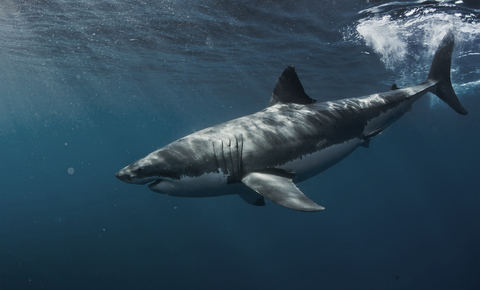

Once thought to be virtually nonexistent in the Bahama Islands, a new study published in the journal Frontiers shows that great white sharks are more common visitors than previously thought. A team of researchers, using acoustic tracking to monitor the movements of white sharks, found nearly a dozen visits by white sharks over a five-year period.
“Historically, it’s been assumed that a lack of sightings means white sharks don’t visit The Bahamas at all. However, our study suggests human activity and white shark habitat may simply not overlap, with white sharks visiting deeper reef waters between dusk and dawn as they migrate through the area,” said Dr. Tristan Guttridge. “These findings highlight how much more we have to learn about these beautiful creatures and how much more research is needed.”
The white shark, Carcharodon carcharias, is an iconic apex predator, playing an important ecological role across its range. Persistent bycatch and overfishing led to white shark declines, but recent studies in the North Western Atlantic (NWA) revealed evidence for regional recovery, and highlighted the importance of Southeastern Florida and the Gulf of Mexico as overwintering grounds for maturing white sharks.

Despite its proximity to Florida and comparably productive habitats, records of white sharks in the Bahamas are extremely rare, with a comprehensive survey of sightings and captures describing only one white shark from 1800 to 2010.
In this study, the researchers used acoustic tracking technology to monitor white shark space use, detecting ten different sharks from 2020 to 2024 along the western edge of the Tongue of the Ocean off Central Andros Island, The Bahamas. Both female and male white sharks, ranging in size from 2.1 – 3.7 m, had originally been tagged with acoustic trackers off the coast of the United States and Canada, and were detected on receivers deployed off Andros Island, The Bahamas from November to May.
White sharks were detected along the drop-off zone along the fringing reef at a depth of about 25 meters, exclusively between dusk and dawn, with the number of detections suggesting transient behavior.
“These findings expand our knowledge of white shark distribution off the Atlantic coast, highlighting data gaps in The Bahamas and underlining the importance of collaborative protective measures for species recovery,” said Dr. Megan Winton.
The study was conducted by Tristan L. Guttridge, Philip Matich, and Annie E. Guttridge of Saving the Blue; Megan Winton of the Atlantic White Shark Conservancy; Simon Dedman of Florida International University; and Greg Skomal of the Massachusetts Division of Marine Fisheries.
Follow Chester Moore and Higher Calling Wildlife® on the following social media platforms
@thechestermoore on Instagram
Higher Calling Wildlife on Facebook
Email Chester at chester@chestermoore.com.
Subscribe to the Dark Outdoors and Higher Calling Wildlife podcasts on all major podcasting platforms.





Leave a Reply