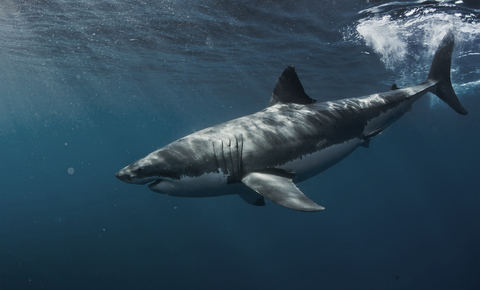
What are the odds of meeting the same great white shark twice, hundreds of miles apart?
Dr. Megan Winton has spent years studying white sharks and today serves as chief scientist of the Atlantic White Shark Conservancy (AWSC). She knows individual sharks can return to familiar areas, and she knows better than most just how much ocean these incredible animals can cover.
But this was different.
In December, Winton was off South Carolina, where she tagged a young female white shark named Freeman with the help of Chip Michalove of Outcast Sport Fishing. Winton photographed and filmed the shark, documenting the markings that could help identify her in the future, and Freeman disappeared back into the Atlantic.
Months passed. Freeman traveled north, and eventually her SPOT tag transmitted from Cape Cod Bay. Winton knew the shark was somewhere in the region and hoped she might have the incredibly rare opportunity to actually see her again.
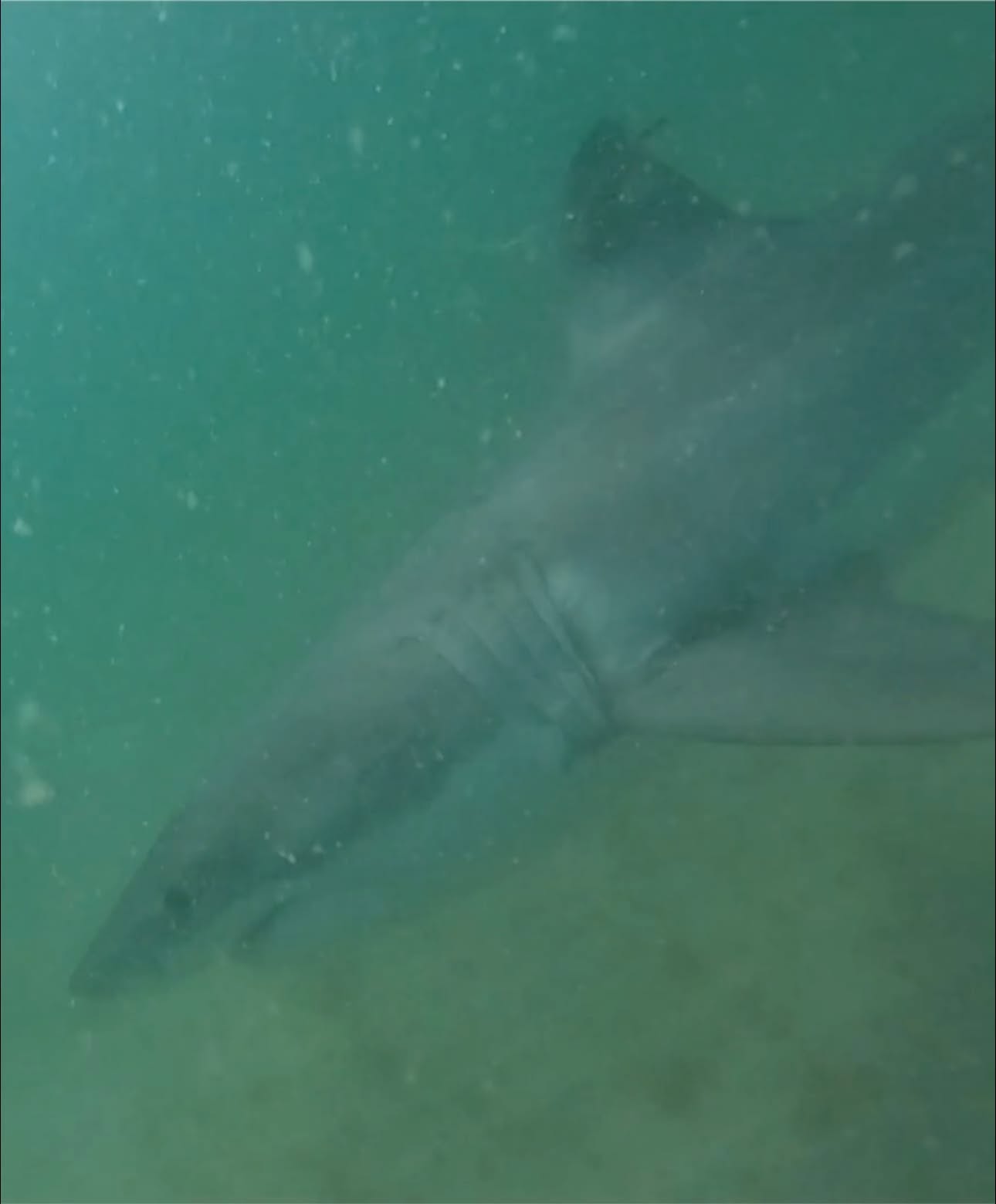
Then, hundreds of miles from where Freeman had been tagged, Winton was conducting research off Cape Cod with Dr. Greg Skomal of the Massachusetts Division of Marine Fisheries when a great white moved beneath the boat.

The shark stayed deep, and nobody aboard realized exactly who had just paid them a visit.
That revelation came when the team returned and reviewed its underwater video. There was a SPOT tag on the shark, immediately narrowing the possibilities. The team compared the footage with images of individually identified sharks in the AWSC White Shark Catalog, looking at the animal’s markings and other distinguishing features.
The identification was stunning. The shark beneath the boat was the same young female Winton had worked with hundreds of miles to the south.
Somehow, across hundreds of miles of Atlantic, their paths had crossed again.
“It’s been the highlight of my season up here so far,” Winton said.
Consider the scale of that for a moment. The Northwest Atlantic is an enormous place, and white sharks are among its great travelers. Freeman could have been almost anywhere along her migration, yet Winton managed to cross paths with the same individual in two different places and two different seasons.
“I don’t know how many people can say they’ve seen the same white shark in multiple places along their migration,” she said.
Researchers can recognize sharks returning to the same region year after year, but encountering the same shark at widely separated points along its migration is something else.
“Plenty of us, you know, can say we’ve seen the same one year after year and over and over in the same place, but to see one in two different seasons hundreds of miles apart is pretty wild,” Winton said.
For Winton, the encounter was remarkable. For the rest of us, Freeman’s journey demonstrates something equally exciting: The white sharks swimming off the Carolinas, Florida and other southern waters are connected to a much larger population moving through the Northwest Atlantic.
And sometimes an image can help connect the dots.
The South Carolina Connection
South Carolina has become an important part of this wider picture through AWSC’s work with Michalove. Seeing Freeman turn up again off Cape Cod impressed even someone who has spent considerable time around white sharks.
“They’re so migratory, and man, they cover so much ground,” Michalove said.
“I just think it’s so rare to see another one.”
Michalove also spoke warmly about the relationship that has developed through working with researchers and contributing information from South Carolina.
“It’s obviously great for both of us,” Michalove said.
Freeman is a powerful example of the information that can emerge when opportunities on the water connect with scientific research. Winton tagged and documented her in South Carolina with Michalove’s help. Months later, Winton encountered that same shark hundreds of miles to the north.
Yet Freeman’s tag tells only part of the story.
Every Shark Has an Identity
When Winton worked with Freeman in South Carolina, she made sure to photograph and film the shark’s individual markings.
“I took photographs and videos of all of her markings to add her to the catalog, which is why we do that,” Winton said.
“So we can tell who it is when we see it.”
Electronic tags provide researchers with extraordinary information about shark movements, but photographs can tell their own story. Individual white sharks carry identifying characteristics that allow researchers to compare new images with animals already in their records.
The White Shark Catalog brings those individual records together, and the public can explore that work through AWSC’s White Shark Logbook.
That becomes particularly important because no research team can follow these animals everywhere they travel. A white shark can move hundreds or thousands of miles beyond a primary study area, yet photographs or video captured elsewhere can potentially provide another piece of its story.
That’s why images from fishermen, boaters and divers can matter.
Your Shark Images Could Matter
This is where Freeman’s story becomes particularly important for followers of the Gulf Great White Shark Society.

Winton wants people who photograph or film white sharks within the Northwest Atlantic population’s range to share those images with AWSC. Someone seeing a white shark in southern waters might assume researchers based around Cape Cod wouldn’t be interested.
That would be a mistake.
“If they get video footage or photos of a white shark somewhere, you know, within the northwestern Atlantic population’s range, to submit it to us because these things travel thousands of miles every year,” Winton said.
And this isn’t theoretical.
“We have identified sharks that divers and boaters have gotten footage of off of Florida,” Winton said. “We’ve recognized them as sharks we’ve seen off of Massachusetts before or Canada before.”
Think about that. A diver in Florida may photograph a white shark without realizing scientists in Massachusetts already know that individual. A fisherman could capture video of a shark that hasn’t been documented in a northern study area for years. The image may provide another point in that animal’s journey.
“Somebody who’s down in your neck of the woods might not think it’s relevant,” Winton said. “Like if they see a white shark down there, they might be like, well, it won’t be in these guys’ catalog, but they’re all part of that same population.”
For those of us fascinated by great whites in the Gulf of Mexico, that’s a powerful message. A white shark photographed in the Gulf isn’t isolated from research occurring hundreds or thousands of miles away. The animal could already have a history.
Sharktivity and Citizen Science
AWSC has created ways for the public to contribute observations and images. Sharktivity provides information about white shark sightings and detections, while images captured by the public can contribute to the broader identification effort through the White Shark Logbook.
No research team can be everywhere a great white travels. Fishermen, boaters and divers, however, are spread across an enormous geographic area, and occasionally one of them will be in exactly the right place at the right time.
An image captured during one of those encounters may become more than a memory. If researchers can identify the shark, it can establish another point in the animal’s history or reconnect them with an individual they haven’t documented in years.
An image doesn’t become irrelevant because it was captured far from Cape Cod. The distance may be exactly what makes it interesting.
One Great White Population, An Enormous Ocean
That message resonates strongly with the work of the Gulf Great White Shark Society.
The presence of white sharks in the Gulf of Mexico and across the southern reaches of their Northwest Atlantic range isn’t a disconnected story. These animals are travelers, moving between regions that can seem worlds apart to us. Information collected in one place may suddenly become valuable when that same animal appears hundreds or thousands of miles away.
Freeman makes that reality personal.
Winton tagged and photographed her off South Carolina with Michalove’s help. Freeman returned to the Atlantic and traveled north. Her SPOT tag eventually transmitted from Cape Cod Bay, and then Winton crossed paths with her off Cape Cod without initially realizing the shark swimming beneath the boat was an old acquaintance.

The footage and identification work revealed the connection.
For all of the technology available to modern shark researchers, there remains something deeply human about Freeman’s story. She wasn’t simply another white shark or another point on a tracking map. She was an individual Winton had worked with hundreds of miles away.
Freeman’s story now stretched from South Carolina to Massachusetts, and the ability to recognize individual sharks is allowing researchers to piece together journeys that previous generations could only imagine.
There is also a challenge in Freeman’s story for the rest of us. If you’re fortunate enough to encounter a white shark, document it when it can be done safely and responsibly. Photographs or video showing the animal clearly could prove valuable. Record the location and circumstances of the sighting and share useful observations and imagery with AWSC.
Don’t assume your shark is just another shark.
Somewhere hundreds or thousands of miles away, researchers may already know it.
Much of a great white shark’s life still unfolds beyond human sight. Even with satellite tags, cameras and decades of research, these animals can vanish into an ocean so vast that an enormous predator becomes almost invisible.
Every once in a while, though, the ocean allows two points on that enormous map to connect.
For Freeman, those points were South Carolina and Cape Cod. And against incredible odds, Megan Winton was there for both.
Chester Moore
Follow Chester Moore and Higher Calling Wildlife® on the following social media platforms
@gulfgreatwhitesharksociety on Instagram
@thechestermoore on Instagram
Higher Calling Wildlife on Facebook
Email Chester at chester@chestermoore.com.
Subscribe to the Dark Outdoors podcast on all major podcasting platforms.




Leave a Reply