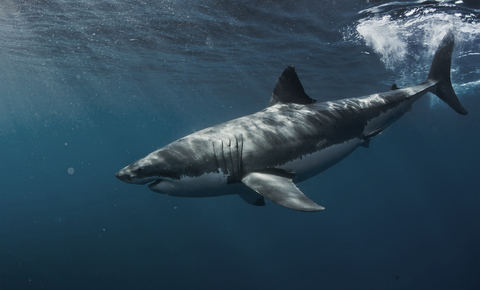

An unusual movement by one of OCEARCH’s most recognizable great white sharks is drawing attention from marine researchers, and The Caledonian Record has highlighted why.
According to The Caledonian Record, Breton—a 1,400-pound adult male great white shark tagged by OCEARCH in 2020—has surprised scientists by turning south toward Florida during the middle of summer instead of continuing north to the rich feeding grounds off New England and Atlantic Canada. The newspaper reported that Breton “surprised scientists by swimming south for summer,” calling the move “a complete break in behavior from the rest of the pack.”
Breton, who has become one of OCEARCH’s best-known sharks through years of satellite tracking, had reached the Carolinas before unexpectedly reversing course. Most mature Atlantic great whites head north during summer and don’t return south until autumn, making Breton’s movement highly unusual.

Having interviewed OCEARCH Senior Data Scientist John Tyminski about Breton on previous occasions, I wasn’t entirely surprised to see the shark making headlines again. Tyminski has long noted that Breton seems to have a habit of defying expectations. In a recent interview with FOX Weather, he reinforced that point, saying, “Sharks don’t always follow the rulebook. Breton’s unexpected journey reminds us that the factors driving white shark movements are complex, and we’re still uncovering the secrets behind these remarkable migrations.”
The report underscores an important reality about great white sharks: despite years of satellite tagging and groundbreaking research, these apex predators continue to surprise even the experts.
Breton’s latest journey also reinforces what recent research has demonstrated about the species’ broader range. Great white sharks are not simply “Cape Cod sharks.” OCEARCH tracking and acoustic detections from the Atlantic White Shark Conservancy have documented numerous white sharks utilizing waters off the southeastern United States and entering the Gulf of Mexico during portions of the year.
For Gulf Coast observers, Breton’s movements serve as another reminder that these sharks are highly mobile predators capable of traveling thousands of miles and responding to environmental cues that scientists are only beginning to understand. Every new satellite ping adds another piece to the puzzle.
As this latest chapter in Breton’s travels shows, even after decades of research and hundreds of tagged sharks, the ocean’s most famous predator still has plenty of secrets left to reveal and, as Tyminski has told me more than once, these sharks don’t always follow the rules.
Chester Moore
Follow Chester Moore and Higher Calling Wildlife® on the following social media platforms
@gulfgreatwhitesharksociety on Instagram
@thechestermoore on Instagram
Higher Calling Wildlife on Facebook
Email Chester at chester@chestermoore.com.
Subscribe to the Dark Outdoors podcast on all major podcasting platforms.






Leave a Reply