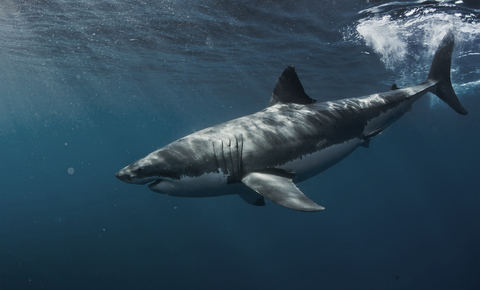
Few sharks have earned a reputation quite like the bull shark.
Powerful, adaptable and capable of moving from the open Gulf into bays, rivers and estuaries, they are among the most successful apex predators in North American waters. Their willingness to venture into shallow water has made them familiar to anglers across the Gulf Coast, yet most people have little idea just how large these sharks can become.
While the average bull shark is an impressive fish, the record books tell a different story altogether. Official state records from around the Gulf reveal sharks weighing well over 500 pounds, proving that this species ranks among the true giants of America’s coastal waters.
Florida’s Gulf Giant
The largest officially recorded Gulf Coast bull shark belongs to Florida.
Florida’s all-tackle state record weighed an incredible 517 pounds, 7 ounces, caught off Panama City in 1981. More than four decades later, it remains one of the largest documented bull sharks ever landed in Gulf waters.
Texas’s 515-Pound Monster
Texas is close behind.
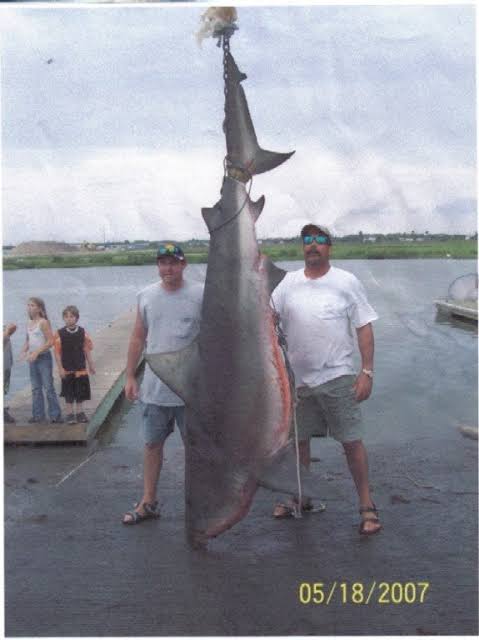
The Lone Star State’s all-tackle record is a 515-pound bull shark caught by Randall Rickerson in Aransas Bay on May 18, 2007. Measuring nine feet long, it remains one of the most impressive sharks ever entered into the Texas record books.

Although Texas anglers occasionally encounter tiger sharks and the rare great white, the bull shark is by far the large coastal predator they are most likely to hook.
Alabama’s Modern Giant
These record fish aren’t simply relics from another era.
In July 2024, Tommy J. Bowyer landed a 494-pound, 8-ounce bull shark during the Alabama Deep Sea Fishing Rodeo near Dauphin Island, establishing a new state record and reminding anglers that the Gulf is still capable of producing truly massive bull sharks.
Mississippi’s Heavyweight
Mississippi’s state record stands at 377 pounds, 4 ounces, caught by David Rogers during the Mississippi Deep Sea Fishing Rodeo on July 1, 2021.
While smaller than the Texas and Florida giants, it still represents an extraordinary bull shark and shows that trophy-class fish can be found throughout the northern Gulf.
Louisiana’s Missing Record
One interesting exception among Gulf states is Louisiana.
The Louisiana Outdoor Writers Association maintains an extensive collection of official state fish records covering numerous freshwater and saltwater species. Surprisingly, however, there is currently no official bull shark category.
That doesn’t mean Louisiana lacks giant bull sharks.
In fact, Louisiana’s sprawling marshes, bays and estuaries are considered some of the most important bull shark nursery habitat anywhere in the Gulf of Mexico. Female bull sharks regularly move into these protected coastal waters to give birth, leaving their pups to spend their earliest months in areas rich with food and relatively safe from larger predators before venturing into open Gulf waters.
A Tiny Shark That Changed My Perspective
I learned just how important those nursery areas are back in 1999.
At the time, I was just beginning my career writing about sharks and had the opportunity to assist John Tyminski, then a researcher with Mote Marine Laboratory, on a Texas blacktip shark tagging project. Long before he became chief data scientist for OCEARCH and helped lead some of the world’s most important great white shark research, Tyminski was teaching me the fundamentals of shark science in the field.
One day we pulled a small shark from one of our nets. At first glance it didn’t seem particularly remarkable. It was a bull shark measuring only about two and a half feet long.
As John examined the fish, he pointed out something I had completely missed.
The tiny shark still had its umbilical cord attached.
“It’s a neonatal,” he said.
That simple observation changed the way I looked at bull sharks forever.
This wasn’t simply a young shark. It had been born only recently, almost certainly after its mother moved into shallow coastal waters near the jetties or another protected nursery area to give birth. Standing there holding that tiny shark, I couldn’t help but think about its mother.
She wasn’t some distant offshore predator. She was likely a mature female weighing several hundred pounds that had quietly slipped into shallow Texas waters, delivered her pups and disappeared back into the Gulf without anyone on the beach ever knowing she had been there.
It drove home a lesson I’ve never forgotten. Every one of the giant bull sharks that makes the record books begins life in places many Texans fish, kayak and swim every day.
Built to Become Giants
Bull sharks possess a unique combination of traits that allows them to thrive throughout the Gulf. Their ability to tolerate both fresh and saltwater gives them access to rivers, bays, estuaries and coastal marshes that many other large sharks cannot exploit. Combined with warm water, abundant prey and a long growing season, those conditions allow some individuals—particularly large females—to reach extraordinary size.
Most anglers will never encounter a 500-pound bull shark. The vast majority of fish caught along the Gulf Coast are much smaller.
But the record books prove those giants are out there.
Whether it’s Florida’s 517-pound record, Texas’ 515-pound behemoth or Alabama’s nearly 500-pound newcomer, these remarkable catches remind us that the Gulf of Mexico remains one of the finest places on Earth for one of the ocean’s most adaptable and powerful predators.
Official Gulf Coast Bull Shark Records
- Florida: 517 pounds, 7 ounces — Panama City (1981)
- Texas: 515 pounds — Aransas Bay (2007)
- Alabama: 494 pounds, 8 ounces — Dauphin Island (2024)
- Mississippi: 377 pounds, 4 ounces — Mississippi Deep Sea Fishing Rodeo (2021)
These remarkable fish are more than impressive entries in a record book. They offer a glimpse into the incredible growth potential of a species that has quietly patrolled Gulf waters for thousands of years and continues to rank among the region’s true apex predators.
Chester Moore
Follow Chester Moore and Higher Calling Wildlife® on the following social media platforms
@gulfgreatwhitesharksociety on Instagram
@thechestermoore on Instagram
Higher Calling Wildlife on Facebook
Email Chester at chester@chestermoore.com.
Subscribe to the Dark Outdoors podcast on all major podcasting platforms.


Leave a Reply