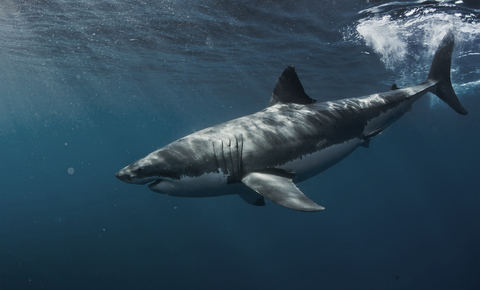

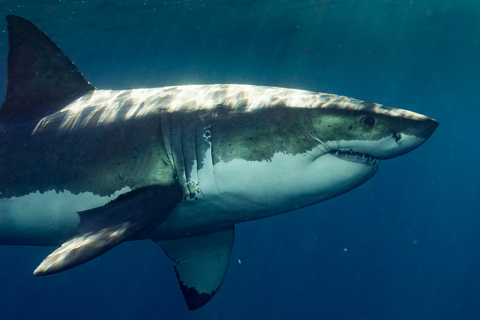
For years, the idea of great white sharks in the Gulf was dismissed outright. Whites were considered animals of cold, open oceans and seal-rich coastlines, not warm, muddy Gulf waters. But as the work behind Gulf Great Whites has grown, one thing has become increasingly difficult to ignore: the northern Gulf, and especially the waters offshore of New Orleans and the Chandeleur Islands, keeps showing up in the story.
That pattern did not begin with satellite tags.
From our anecdotal reports which you can read in our database-dating back to the 1980s, offshore oilfield workers, commercial fishermen, and recreational anglers have described seeing extremely large sharks with classic great white characteristics in this same general region. Many of these reports came from night operations around oil platforms south of New Orleans, where powerful lights illuminated massive shapes rising from deep water. At the time, these accounts were easy to dismiss. Without photographs or tagging data, they lived in the uncomfortable gray area between legend and likelihood.
Learn more about great white sharks in the Gulf →
👉 https://gulfgreatwhites.com/great-white-sharks-in-the-gulf-of-mexico-complete-guide/
But the details kept repeating.
Winter months. Deep water nearby. Proximity to strong currents and productive edges. Sharks that behaved differently than bulls or tigers. With hindsight, those early reports don’t read like random exaggeration. They read like early signals.
Modern tagging data has since changed the conversation, but it’s important to be precise about what that data actually shows with tagged white sharks from OCEARCH not only showing in Gulf waters but south of the Big Easy.
In 2024, tagged sharks Keiji, Crystal and Rose hung out in this area.

The importance of the New Orleans–Chandeleur region does not hinge a few famous sharks. It rests on the overlap between decades of anecdotal reports from this specific area and modern data confirming that white sharks do use the Gulf.
So what makes this stretch of water different?
Geographically, the area sits at a crossroads of productivity. The Mississippi River outflow injects massive amounts of nutrients into the northern Gulf, fueling plankton blooms that support baitfish, squid, and larger predators. This productivity cascades upward, creating one of the richest marine food webs in the region. Anglers have known this long before scientists mapped it.
Offshore of the Chandeleur Islands lies one of the Gulf’s most consistent tuna and wahoo fisheries. Blackfin tuna stack up in winter. Yellowfin roam the deeper edges. Wahoo slash temperature breaks. Serious fishermen know that cooler months often produce the best action here.
That seasonal detail is important.
White sharks tracked in the western Atlantic tend to appear in the Gulf during cooler months as well. The timing overlaps almost perfectly with peak tuna and wahoo activity. Is that coincidence, or connection?
Great whites are highly mobile apex predators built to follow high-calorie prey. In other parts of the world, white shark hotspots line up with predictable food sources. The northern Gulf lacks seal colonies, but it does host dense seasonal concentrations of tuna, wahoo, bonito, dolphins, and other large fish. Where that prey concentrates, apex predators tend to follow—often deeper, often unseen.
From our anecdotal reports, many early sightings near Louisiana occurred in winter, frequently at night, and often around oil platforms. These structures act as artificial reefs, concentrating baitfish and squid and creating feeding opportunities that ripple up the food chain. Add deep water, strong currents, and seasonal cooling, and the habitat begins to resemble known white shark foraging zones elsewhere in the world.
Rather than viewing the northern Gulf as an anomaly for great white sharks, it may make more sense to see it as an under-recognized seasonal corridor or feeding area—one that went undocumented for decades because we lacked the tools and the willingness to accept what people were seeing.
What we are witnessing now is alignment.
Historical eyewitness accounts from our database line up with modern satellite tracking. Fishing patterns line up with shark movements. Oceanography lines up with predator behavior.
That doesn’t mean great whites are suddenly common in the Gulf, and it doesn’t mean they pose a new risk. It means the Gulf is more complex, more productive, and more connected than it has long been given credit for.
The waters offshore of New Orleans and the Chandeleur Islands are not random dots on a map. They may even represent one of the most overlooked pieces of the great white shark puzzle in the Gulf region.
The real question is no longer whether great white sharks belong here.
It’s how long they’ve been coming—and what else we still haven’t noticed.
Chester Moore
Follow Chester Moore and Higher Calling Wildlife® on the following social media platforms
Learn more about great white sharks in the Gulf →
👉 https://gulfgreatwhites.com/great-white-sharks-in-the-gulf-of-mexico-complete-guide/
@thechestermoore on Instagram
Higher Calling Wildlife on Facebook
Email Chester at chester@chestermoore.com.
Subscribe to the Dark Outdoors and Higher Calling Wildlife podcasts on all major podcasting platforms.

Leave a Reply