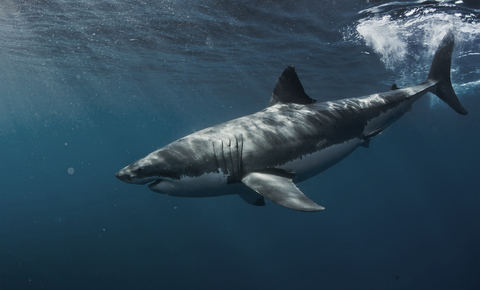

Shark.
Say that word anywhere and people pay attention. Shout it at the beach and you’ll see folks scrambling for dry sand. Few animals trigger such an instant, visceral reaction.
Yet sharks are among the most fascinating and misunderstood creatures in the ocean. I want to take this time to share a few encounters that shaped my own respect for these animals.
Blacktip sharks are the most common large shark species in Southeast Texas waters, and years ago I witnessed one of the most unforgettable blacktip encounters of my life.
I was fishing off the shores of Breton Island in the Chandeleur Islands, just off Venice, Louisiana, with Capt. George Knighten. We were wading shallow water when a school of mullet in front of us went from nervous to absolutely panicked. Mullet exploded out of the water in every direction, fleeing something just beneath the surface—something about two-and-a-half feet long and moving fast.

Knighten, who was wading ahead of me, fired a MirrOlure Top Dog into the chaos, fully expecting a big sow speckled trout. Instead, the water erupted as a juvenile blacktip shark crushed the plug. At the time, Top Dogs were hot commodities, and Knighten tried to horse the fish in to save his lure. The shark had other plans. Its rough, sandpaper-like skin snapped the line, and it vanished into a small channel along the island.
Two days later, just before heading back to the mainland, Knighten and I found ourselves wading that exact same stretch of shoreline, catching a solid string of trout. As we worked the area, Knighten suddenly yelled, “Shark!”
A blacktip had grabbed his stringer and was helping itself to an easy meal.
“You’re not going to believe this,” Knighten said.
“This is the same blacktip I lost here two days ago.”
“How do you know?” I asked.
“My plug is still in its mouth.”
Whether that proves blacktips are territorial is debatable, but it does illustrate their persistence and adaptability—traits that have allowed this species to remain strong while others have declined.
Blacktips may be underappreciated, but almost everyone has heard of the bull shark’s reputation.
A few years later on that same general stretch of shoreline, I caught a five-foot bull shark from a boat positioned just off the drop-off of an island we’d been wade-fishing earlier. Television host Keith Warren was with me and thought it best to photograph the fish from shore. I hopped overboard, waded the shark to the bank, and brought it in while it was still fighting hard.
We filmed the entire process and talked about bull sharks and conservation.
“Sharks like the bull shark can be dangerous to people,” I said on camera, “but they play an incredibly valuable role in nature. They are apex predators in the Gulf of Mexico, and without them, the entire food chain would be disrupted.”
I occasionally keep sharks to eat, but bull sharks have extremely thick hides and strong ammonia levels in their meat. I decided this one deserved to fight another day.
Keith and I walked the shark back into the water, and he demonstrated how to properly revive a fish by pushing water through its gills. The shark appeared exhausted but soon regained its strength. Keith nudged it toward deeper water, we exchanged a few closing remarks, and started walking back to shore.
Then I noticed something that made my stomach tighten.
The shark had swum about 20 yards out, then turned around and headed straight back toward us. We were in knee-deep water, a good 30 yards from the bank. There was no outrunning a bull shark. I prepared to kick if I had to.
At about 10 feet away, the shark turned sideways as if asserting dominance—then calmly veered off in the opposite direction. We both exhaled at once. Thankfully, the camera was still rolling, because I doubt anyone would have believed us otherwise.
If that wasn’t ironic enough, tagging sharks near Sabine Pass brought the lesson even closer to home.
I was fishing with Bill Killian, and my late friend Clint Starling was along, eager to catch his first shark. We set up near a rig about ten miles south of the jetties and started catching sharks immediately—blacktips, spinners, and mostly Atlantic sharpnose sharks, a species often called “sand sharks” that max out around four feet.
As I was fitting a three-foot Atlantic sharpnose with a tag for a shark movement study, a massive crew boat thundered past about 50 yards away, throwing a wave that nearly capsized us. Gear went flying—including the shark.

When the boat settled, the shark landed on my leg and clamped onto my calf. Sharks don’t nip; they grab and tear. Luckily, I knocked it loose before it could take a chunk. Blood poured down my leg.
Bill and Clint panicked. I told them to calm down and asked for alcohol or peroxide. They had neither. The only thing handy was a can of Dr. Pepper. I poured it on the wound, wrapped it with my bandana, and stopped the bleeding. Bill wanted to head in, but the fish were still biting. We stayed another couple of hours and caught plenty more sharks.
That shark left me with a perfect jaw-shaped scar and a lasting reminder: sharks are wild animals, even when you’re trying to help them. I never needed stitches, and that scar has been with me since 1999.
The real irony is that after all of that, my fascination with sharks never faded—it grew.
Sharks aren’t monsters. They are ancient, efficient predators that keep the ocean in balance. They deserve respect, not fear. In a world where so much wildlife is disappearing, sharks remain a powerful symbol of what the ocean once was—and what it still can be, if we choose understanding over hysteria.
And that’s exactly why people can’t stop talking about sharks.
Chester Moore
Follow Chester Moore and Higher Calling Wildlife® on the following social media platforms
@thechestermoore on Instagram
Higher Calling Wildlife on Facebook
Email Chester at chester@chestermoore.com.
Subscribe to the Dark Outdoors and Higher Calling Wildlife podcasts on all major podcasting platforms.




Leave a Reply