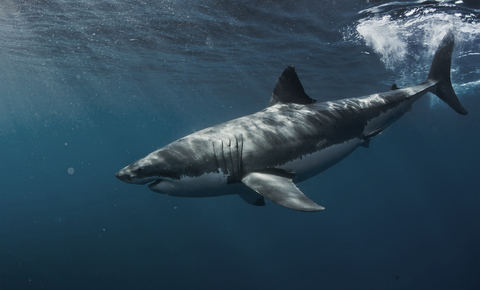

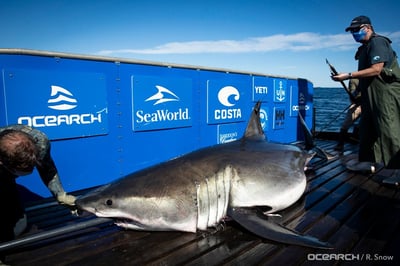
The Atlantic off Nova Scotia has always carried a sense of mystery. Fog sweeps across rocky headlands, lobster boats cut through gray swells, and beneath it all move shadows few believed would ever return. For generations, white sharks were little more than a rumor here — a tooth found in an old boat, a fisherman’s tall tale. That picture is changing, and fast. OCEARCH science program manager John Tyminski has followed the digital breadcrumbs left by tagged sharks into Canadian waters.
What he and his colleagues have found is forcing scientists, policymakers, and coastal communities to reconsider what they thought they knew about one of the ocean’s most powerful predators.

Following the Tracks
“We did most of our tagging in the southeast, off the Georgia–Florida border and the Carolinas. A couple of key animals — Lydia and Hilton — gave us the first big clues,” Tyminski said.

“Their tracks went up along Nova Scotia and into the south of Newfoundland, and that’s when we realized Canada was pretty important. Prior to that, the understanding was that it was on the outskirts of the range.”
Those tracks revealed surprises that still ripple through shark science today. Katherine and Lydia, two large females tagged in the southeast, made clear moves into Canadian waters. Hilton, a mature male, led researchers straight into Mahone Bay. What was once considered marginal habitat suddenly looked central.
“It was shocking,” said Canadian scientist Dr. Nigel Hussey, director of the Tancook Islands Marine Field Station. When he joined OCEARCH’s first Canadian expedition in 2018, he half-joked that finding sharks would be like searching for a needle in a haystack.
“I had to eat my hat,” Hussey admitted. Within three weeks, they had tagged eight animals.
Sharks with Canadian Passports
As more sharks were tracked, a pattern emerged. They weren’t one-off visitors. They were returning to Canada season after season.
“For me, it was like realizing these animals have Canadian passports,” Tyminski said.
“They’re not just passing through. They’re choosing to be there.”
That choice has enormous implications. For decades, Canada didn’t even have a management plan for white sharks. Their rarity made them seem peripheral. Now, with evidence that dozens (perhaps hundreds or more) frequent Atlantic Canada each year, conservation strategies may need to shift northward.
Hussey agrees.
“These animals are actually residents in Atlantic Canada waters, and that has real implications on many different levels.”
Building a Base in Mahone Bay
One of the most important steps in advancing that science was the creation of the Tancook Islands Marine Field Station in Mahone Bay.
“The work Nigel has done with that station is critical,” Tyminski said.
“It’s embedded in the community, with fishermen helping deploy receivers and students living there for months at a time. It’s become a true hub of Canadian white shark research.”

For Hussey, the field station was about bridging gaps.
“Fishermen and scientists are like polar opposites,” he explained.
“But fishermen are on the water every day. They have generations of knowledge. If you can bridge that gap, then scientists can do their part in terms of generating and analyzing data.”
Listening for Giants
From Tancook, Hussey’s team and OCEARCH collaborators have built a remarkable array of more than 80 acoustic receivers across Mahone Bay and beyond. Each device sits on the seabed, recording the coded signals from tagged sharks.
“No one’s going to put a firm number on it,” Tyminski said. “But based on those detections, you have to think in the thousands, not the hundreds.”
To complement tagging, Hussey’s students use baited remote underwater video systems (BRUVs) made from old lobster traps. Footage helps identify untagged sharks by scars and markings, linking Canadian sightings with photo-ID catalogs built in Cape Cod and elsewhere.
Cold-Water Pioneers
Some of the sharks have stunned researchers with how far into the cold they’ll go. Helena, a female tagged by OCEARCH, was tracked south of Newfoundland on the Grand Banks.

“She experienced temperatures as low as 0.9°C,” Tyminski said.
“That’s very, very cold water, but these animals can handle it at least for a period of time.”
The discovery expands the known boundaries of white shark tolerance. For decades, cold waters were seen as a limiting factor. Now, Nova Scotia’s frigid bays are clearly within their comfort zone.
A Changing Ocean
Why now? That’s the question Tyminski keeps circling back to.
“Cape Cod is seeing fewer animals compared to some past years,” he said.
“At the same time, detections in Canada are increasing. I’m not willing to say there’s a distribution change yet, but it could be, and the evidence is worth watching.”
Hussey points to the larger context. Other sharks, like blacktips in Florida, are shifting ranges as warming seas alter migration corridors.

“If warming seas are pushing sharks north, then Atlantic Canada may become even more important in the years to come,” he said.
“That makes it critical we understand their patterns now, before those changes accelerate.”
Faces of the Sharks
Every tagged shark adds another piece to the puzzle — and often a story. Jason, named for a late friend of Hussey’s, provides a living legacy for his family. Baker, named after harbor master David Baker, became a local icon when he burst a buoy that now hangs from David’s lobster boat. Blossom, named after the field station’s cat, was first recorded on camera before being tagged.
“These names and stories matter,” Tyminski said.
“They connect people to the science. When you can follow Jason or Hilton on the tracker, you’re not just looking at data points. You’re following an individual animal.”
Looking Ahead
The work is still in its early stages. OCEARCH is in a period of transition, with its flagship vessel undergoing major refitting and a new shark-specific catamaran still under construction. In the meantime, collaborations with the Tancook station ensure momentum.
In one summer alone, seven new sharks were tagged in Mahone Bay — Jason, Bella, Baker, Blossom, Quint, Percy, and Kyo. Each expands the dataset needed to eventually answer the big questions:
How many sharks are there? What migration corridors do they use? How often do they feed? How do they shape the ecosystem?
It will take years, Tyminski admits. But the foundation is there. And each season brings new returns, new data, and new reasons to protect these waters.
Legacy in the Fog
As evening falls on Mahone Bay, acoustic receivers wait silently below the waves. A shark passes within range, sending a coded ping that logs another chapter in a story still unfolding. Onshore, students at the field station download the data, adding one more movement to a growing portrait of Atlantic Canada’s white shark population.
What was once dismissed as rare is now understood as routine. Great whites are not only returning but in some ways they seem to be thriving.
Chester Moore
Follow Chester Moore and Higher Calling Wildlife® on the following social media platforms
@thechestermoore on Instagram
Higher Calling Wildlife on Facebook
Email Chester at chester@chestermoore.com.
Subscribe to the Dark Outdoors and Higher Calling Wildlife podcasts on all major podcasting platforms.



Leave a Reply