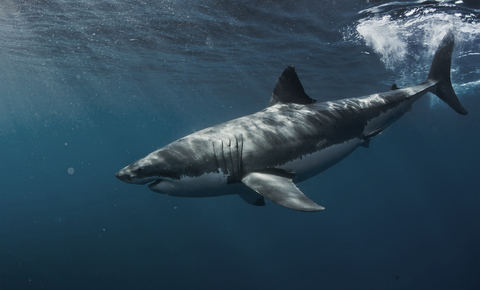

For decades, the story of sharks and seals off Cape Cod has been largely told in media through a single lens. Gray seals returned. White sharks followed.
That story is still true—but there’s more.
In the summer of 2023, a series of observations off Nantucket quietly rewrote part of what scientists thought they understood about large sharks in the Northwest Atlantic. The predators involved weren’t white sharks. They were dusky sharks—an endangered, poorly understood species that many people have never even heard of, let alone imagined hunting seals in shallow New England waters.

What followed was one of the most important shark behavior discoveries in recent memory: the first unequivocal documentation of dusky sharks actively preying on gray seals, captured on drone footage and described in detail by a research team led by Dr. Megan Winton of the Atlantic White Shark Conservancy. The findings were formally published in the peer-reviewed study Dusky sharks actively prey on gray seals, authored by Winton along with Ashleigh J. Novak, Victoria L. Migneco, John Chisholm, and Gregory B. Skomal in Environmental Biology of Fishes in 2025.
It didn’t just add a new chapter to shark science. It forced scientists to rethink how recovery, conservation, and predator ecosystems actually work.
An Obscure Shark with a Complicated History
Dusky sharks (Carcharhinus obscurus) are large requiem sharks in the family Carcharhinidae that can exceed 12 feet in length. They are powerful, wide-ranging predators—but they don’t look the part in the way white sharks do. No iconic silhouette. No dramatic coloration. Just a long, gray, streamlined shark that blends easily into the background.
That anonymity comes at a cost.
“They’re one of those sharks people don’t really know,” Winton said.
“They’re often confused with other gray sharks, and because their population was hit so hard by fishing, there was a long time when they were basically invisible to the public.”
Dusky sharks were heavily impacted by commercial fishing in the 1970s and 1980s. They are slow-growing, late-maturing, and long-lived—traits that make recovery painfully slow. In U.S. waters they are now a prohibited species, protected from harvest, but globally they are still considered endangered.
For years, most of what scientists knew about dusky sharks came from fisheries data and stomach-content studies. Direct observations of their hunting behavior were rare. Seal predation wasn’t even considered part of their ecological role.
Until Nantucket.
When the Wrong Shark Got the Blame
In early July 2023, beachgoers and boaters reported multiple shark predation events on gray seals near Great Point on Nantucket. Beaches were temporarily closed. The assumption was immediate and familiar: white sharks were feeding on seals close to shore.
But when scientists reviewed the photos and video footage being shared by the public, something didn’t add up.

“These weren’t white sharks,” Winton said.
Subtle anatomical details in the footage ruled out white sharks and pointed instead to sharks in the genus Carcharhinus.
“Once we realized that, we knew we had to go look.”
Researchers from the Atlantic White Shark Conservancy mobilized quickly. With the help of an experienced spotter pilot, underwater cameras, and later aerial drones, the team identified at least four individual dusky sharks—large females—actively using the shallow waters off Great Point.
Then came the footage that changed everything.
A First in Shark Science
During the summer of 2023, drone surveys conducted by the Atlantic White Shark Conservancy documented a complete predation event involving two dusky sharks pursuing, killing, and consuming a young gray seal in shallow water off Nantucket.
This was not scavenging. It was not opportunistic feeding. It was coordinated, deliberate predation.

“This was the first time we’ve ever had unequivocal evidence of dusky sharks actively preying on seals,” Winton said. “From a shark science perspective, that’s huge—because we didn’t even know they were capable of doing that.”
The footage showed one shark overtaking the seal, pinning it to the seafloor, delivering fatal bites, and consuming it, while a second shark joined in moments later, tearing away pieces of the carcass. Within minutes, nothing remained.
The behavior closely mirrored seal-predation strategies previously documented in white sharks and other large predators—but it was happening in a species never before confirmed to hunt marine mammals this way.
The study further notes that at least three additional gray seals were likely consumed by dusky sharks in the same area during the summer of 2023, based on eyewitness accounts, beach closures, and video evidence reviewed by the research team.
Built for Shallow Water
One of the most surprising aspects of the discovery wasn’t just that dusky sharks were eating seals—but how they were doing it.
Dusky sharks are more slender than white sharks. They don’t have the same bulk or massive girth. That turns out to be an advantage.
“They can get into shallower water than white sharks can,” Winton explained. “That allows them to access seals very close to shore.”
Gray seals frequently move between haul-out sites and shallow feeding areas. Juvenile and post-weaned pups, in particular, make short forays offshore to feed on sand lance and other prey. That movement corridor—just beyond the beach—puts them squarely within reach of dusky sharks.
The footage from Nantucket showed seals entering deeper water, encountering sharks, and being intercepted before they could return to shore.
Pack Hunters, Not Lone Wolves
The discovery also fits into a broader pattern that scientists are only beginning to understand: dusky sharks are capable of cooperative or pack hunting.
In previous research conducted elsewhere, groups of dusky sharks have been documented attacking large prey, including dolphins and even a humpback whale calf. Similar behaviors may explain observations of multiple sharks surrounding larger seals off Nantucket.
“Pack hunting is not something we see in most shark species,” Winton said. “But dusky sharks seem capable of it, and that opens up a whole new understanding of what they can do as predators.”
In some cases, multiple sharks may also be engaging in kleptoparasitism—stealing prey killed by another shark—another behavior rarely documented in large sharks.
A Recovering System Reveals Old Truths
The return of dusky sharks to Cape Cod waters isn’t happening in isolation. It’s part of a much larger ecological recovery.
Gray seals rebounded following the Marine Mammal Protection Act. White sharks increased following fishing prohibitions and prey availability. Now, dusky sharks—long suppressed by overfishing—appear as if they could be reclaiming part of their historical range.
“We’re likely seeing predator–prey interactions that existed here long before people were watching,” Winton said. “We just never had the chance to observe them.”
For centuries, human pressure removed key predators and prey from the system. Only now, with protections in place and new technologies like drones and citizen-science reporting, are scientists able to witness how these ecosystems actually function.
Citizen Science Changed the Outcome
This discovery would not have happened without members of the public sharing photos, videos, and observations.
“If people hadn’t sent in footage, we would have assumed these were white sharks,” Winton said. “Citizen science played a huge role in this.”
Drones flown by beachgoers, videos taken from boats, and eyewitness reports all contributed to identifying the species involved and prompting formal investigation. In an era when nearly everyone carries a camera, rare behaviors that once went unseen can now reshape scientific understanding.
What It Means Going Forward
Dusky sharks are still endangered. Their population recovery is fragile and uneven. Many basic aspects of their biology—migration routes, nursery areas, population structure—remain unknown.
But this discovery matters.
It expands the known ecological role of dusky sharks.
It underscores the complexity of predator recovery.
It reminds us that conservation success doesn’t end with protection—it begins there.
As sharks return to nearshore waters, they will resume behaviors that feel new only because we forgot they existed. That reality brings challenges, especially where humans and predators share the same space. But it also brings something rare in modern conservation: proof that protection works.
The sharks we didn’t know were there were always part of the system. We’re just finally paying attention.
Chester Moore
Editor’s Note: Great white sharks will always be our focus especially in Gulf waters but our mission statement also includes raising awareness of other large sharks. The story of dusky sharks off Nantucket is a reminder that when we pay attention to one species life cycle, we often uncover many more.
Follow Chester Moore and Higher Calling Wildlife® on the following social media platforms
@thechestermoore on Instagram
Higher Calling Wildlife on Facebook
Email Chester at chester@chestermoore.com.
Subscribe to the Dark Outdoors and Higher Calling Wildlife podcasts on all major podcasting platforms.




Leave a Reply