
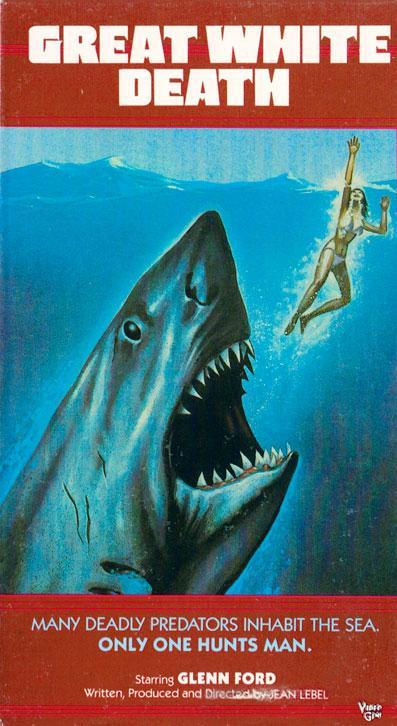
If you’ve ever stared at the classic “Jaws” poster—the swimmer gliding across a pale blue surface while a monstrous shark rockets up from the black—your brain probably filed that animal under great white. The movie’s shark is meant to be a great white, after all. But here’s the delicious twist: the poster shark isn’t a great white at all. It’s based on a shortfin mako—and not just any mako, but a real museum specimen.
And with “Jaws” being re-released into theaters this weekend we thought now was a great time to share this story.

The true story (yep, it’s a mako)
In 1975, illustrator Roger Kastel created the art that would become one of the most recognizable posters in film history. For reference, Kastel headed to New York’s American Museum of Natural History (AMNH) to study preserved sharks. Recent explainers from AMNH’s ichthyology team point to a specific shortfin mako specimen in their collection as the model for the poster’s upward-surging predator. That’s why the head shape, sleek body, and tooth pattern feel more mako-ish than carcharodon.
Over the years, design retrospectives and interviews have backed up the museum connection and the mako “feel.” Kastel reportedly sketched and photographed sharks at the museum to nail the form and menace, then blended that research into the now-iconic composition: a vertical predator, mouth agape, spearing up through the blue void toward an unsuspecting swimmer.
Meanwhile, the swimmer in the image wasn’t a still from the movie—it was a model. Allison Maher (later Allison Maher Stern), then a young Wilhelmina model, posed atop stools in a studio while Kastel directed her into a classic crawl—an ingenious low-tech setup that translated into the perfect silhouette for impending doom.

It’s also worth remembering the poster lineage. The film art evolved from the hit novel’s cover; Peter Benchley’s 1974 book had already popularized the stark concept of a swimmer over a menacing shark. When Universal adapted the story for the screen, Kastel’s meticulous study and painterly menace sharpened that concept into the single image many of us think of when we hear a two-note theme.
Why the mako detail matters
To shark nerds, species matter. Shortfin makos (Isurus oxyrinchus) are the fastest sharks in the ocean, with a torpedo profile, pointed snout, and scythe-like teeth. Those traits (as well as head shape and body taper) line up strikingly with Kastel’s painted animal. A classic great white tends to have a stockier head, different dentition, and a heft that reads differently in profile. If you always wondered why the poster shark looked a touch too sleek for a white, now you know.
We mocked up “species swap” poster concepts
Out of curiosity, we imagined how the famous upward-charging composition might read if the shark were a different species. (See the concept images below.)
- Wobbegong (carpet shark): A bottom-hugging ambush specialist with a flat, camouflaged body and shaggy dermal lobes around the mouth. The classic “rocket from the abyss” pose morphs into a stealthier rise near structure—reefy textures, mottled skin, and tassels that telegraph camouflage over speed.
- Tiger shark (Galeocerdo cuvier): Heavier-bodied with a blunt snout and the trademark dark bars along the sides. The visual reads as a slower but inevitable ascent—broad head, tall dorsal fin, and faint vertical striping etched against midwater haze.
- Bull shark (Carcharhinus leucas): Compact and muscular with a blunt snout and broad, triangular pectorals. Framing it in turbid, coastal water amplifies the bulldog profile; the rise feels like a short, explosive burst rather than a long missile shot.
Note: These are original homage-style illustrations—not replicas of the Jaws poster—created to explore how species-specific anatomy changes the vibe of the same basic composition.


What are your thoughts on these?
Are you going to see “Jaws” in theaters this weekend? I am and can’t wait!
Until then check out our documentary Gulf Great White Sharks: Return of An Icon.
Please share and help spread the word about great white shark conservation awareness in Gulf waters.
Chester Moore
Follow Chester Moore on the following social media platforms
@gulfgreatwhitesharksociety on Instagram
To support the efforts of Higher Calling Wildlife® click here.
Subscribe to the Dark Outdoors podcast on all major podcasting platforms.
Higher Calling Wildlife on Facebook
Email Chester at chester@chestermoore.com.




Leave a Reply