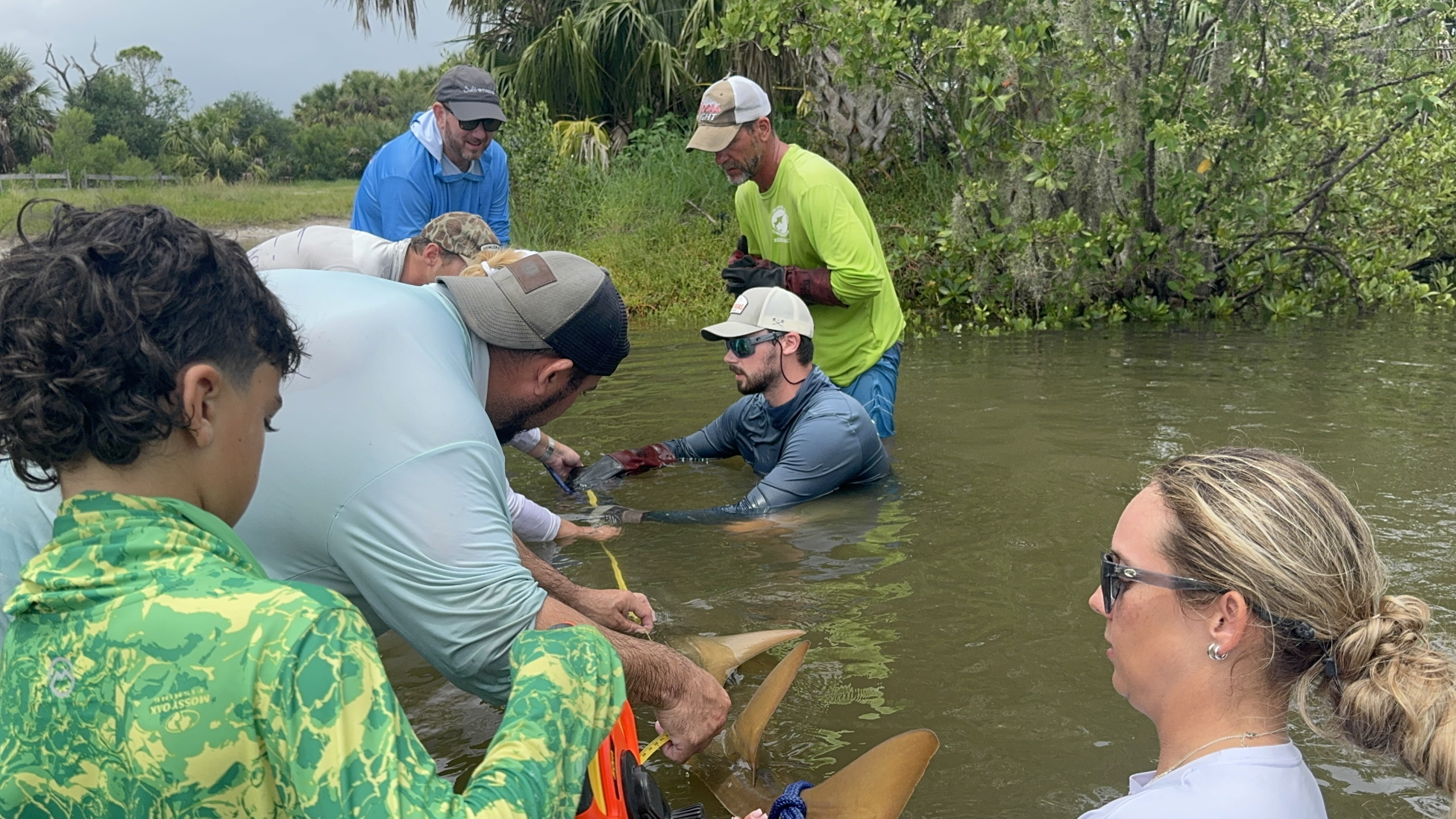
An endangered smalltooth sawfish (close shark cousin) that had been trapped in a lower Tampa Bay wetland was safely relocated on August 9 thanks to a team effort by researchers and concerned citizens.
Following reports from anglers in the area, a team of experts from Havenworth Coastal Conservation (HCC), the Florida Fish and Wildlife Conservation Commission (FWC), and NOAA Fisheries, along with several volunteers, successfully captured, tagged, relocated, and released the fish in open waters of Tampa Bay.

“The sawfish got in the tidal pond either through the culvert grating when it was a small two-foot-long newborn and then grew too large to swim back out or, more likely, swam in when Bishop Harbor Road was flooded during Hurricane Helen,” explained HCC President, Tonya Wiley, who leads the U.S. Sawfish Recovery Team and Tampa Bay sawfish research.
“Given the dire state of the sawfish population, it was critical that we relocate this individual to ensure its ability to adequately forage and resume its natural migration.”
The 7.4 foot (227 cm) female sawfish was fitted with an acoustic transmitter that will send signals to listening stations throughout Florida’s coastal waters and thereby record its movements in Tampa Bay and beyond. In addition to the tagging, researchers collected small biological samples that will be analyzed by experts at Ripley’s Aquarium, the Field Museum, and Texas A&M University-Corpus Christi.
The smalltooth sawfish was once plentiful from Texas to North Carolina but today is found almost exclusively in Florida. Ongoing threats include incidental catch in fishing gear, particularly shrimp trawls, as well as the destruction of key habitats. The smalltooth was listed under the U.S. Endangered Species Act in 2003. Since the winter of 2023, South Florida’s “spinning fish” phenomenon has hit sawfish particularly hard, resulting in more than 60 confirmed mortalities of large juveniles and adults and hundreds of reports of abnormal behavior.
“The precise cause of the spinning sickness and its long-term effects on sawfish are still unknown,” said Adam Brame, the NOAA Fisheries U.S. Sawfish Recovery Coordinator. “Given the already depleted state of the population, we are very worried about their ability to reproduce and fend off extinction and are grateful for efforts like this to maximize the chances for survival of each and every sawfish.”
The successful relocation of the trapped sawfish highlights the importance of public outreach and engagement. The U.S. Sawfish Recovery Team encourages the reporting of all sawfish encounters through www.SawfishRecovery.org, 1-844-4SAWFISH, sawfish@myfwc.com, and/or the FWC Reporter app.
Follow Chester Moore on the following social media platforms
@gulfgreatwhitesharksociety on Instagram
To support the efforts of Higher Calling Wildlife® click here.
Subscribe to the Dark Outdoors podcast on all major podcasting platforms.
Higher Calling Wildlife on Facebook
Email Chester at chester@chestermoore.com.





Leave a Reply