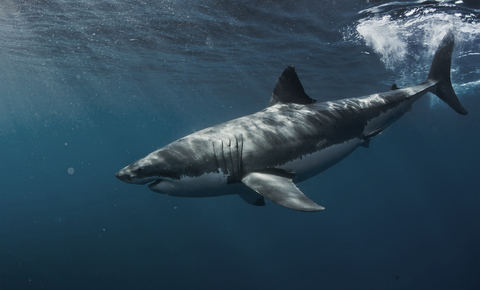
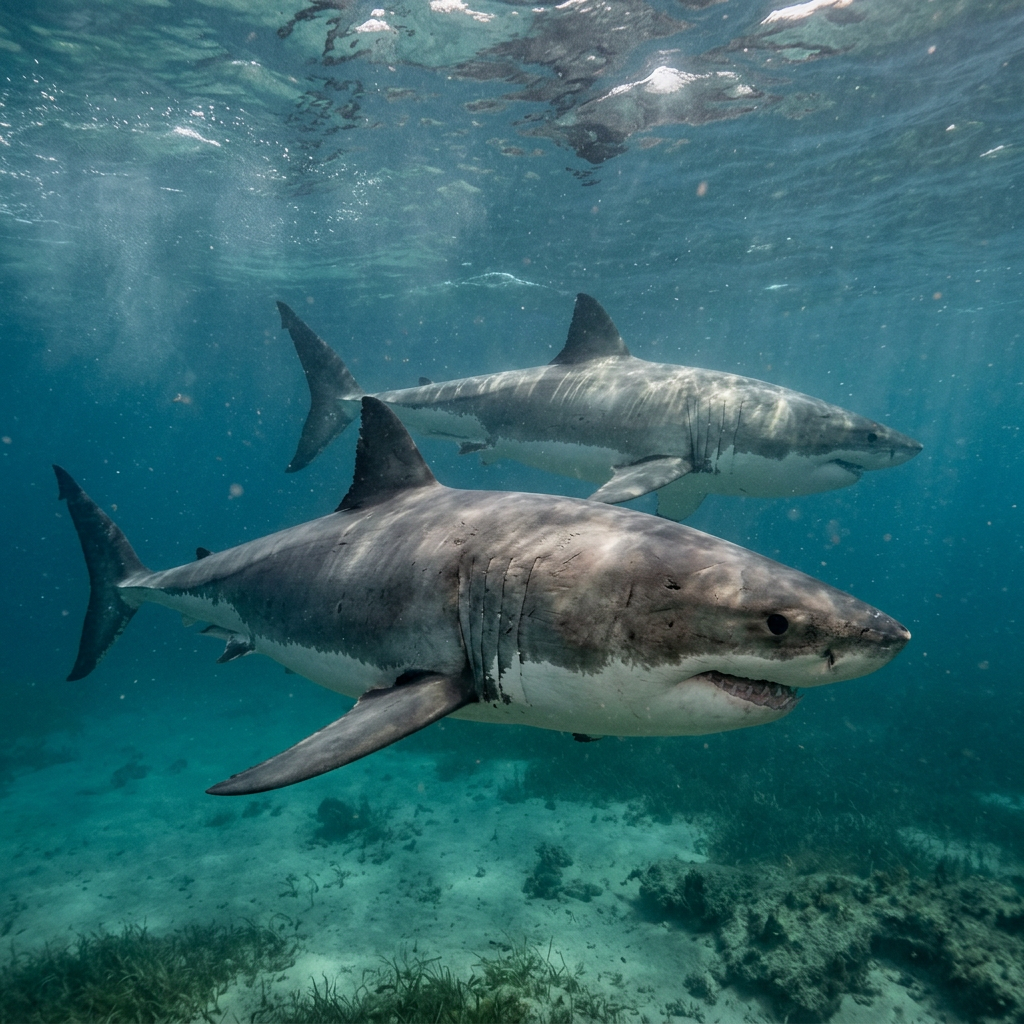
A viral post is making the rounds claiming two tagged great white sharks—“Andrea” and “Lincoln”—are moving into Texas waters, with one near Corpus Christi and the other pushing toward Galveston.
But when you check the actual tracking data, the story falls apart.
There are no verified tagged great white sharks by those names in any legitimate public database, including OCEARCH or the Atlantic White Shark Conservancy. It’s not on Fin Finder (haven’t tagged great whites) or any other app we can find.
If two tracked white sharks were really approaching the Texas coast, it wouldn’t be a mystery but show up clearly in the data.
It doesn’t and the post doesn’t quote any institution, much less a credible one. This is why you see all of our stories have sources or we don’t report them.
The True Identity of Andrea?
Interestingly, there is a green sea turtle named Andrea tagged by OCEARCH in 2019 in Florida but there is not even any recent “pings” in Florida, much less Texas. It is the only Andrea we could find in any database.
(Editor’s Note: How cool is it that OCEARCH tags sea turtles too? It’s just another reason to subscribe to their app.)
We could find no Lincoln at all-not even a turtle.

Same Story-Different Names
And we’ve already seen this exact kind of claim before.
In a recent viral post, two sharks—“Kara” and “Alyssa”—were said to be heading toward Texas. The difference is those sharks are real, verified, and legitimately tagged. We tracked them back to the Marine Conservation Science Institute, which tagged both animals off California as part of a Pacific white shark study.
Kara, a 16-foot female tagged in October 2025, has remained along the West Coast, even ranging up toward the Pacific Northwest. Alyssa, even larger at around 18 feet and tagged in December 2025, has stayed offshore of California as well.
Both sharks are firmly in the Pacific Ocean.
That matters more than anything else in this conversation.
Because for either of those sharks to be anywhere near Texas, they would have to cross an entire continent by land or go through the Panama Canal-or perhaps around the southern tip of South America.
Not gonna happen.

That earlier post has real tagged sharks but in the wrong ocean.
This “Andrea” and “Lincoln” version doesn’t even have that. The names don’t show up in any tracking system at all.
And it’s not just happening in Texas.
This same post has been showing up in multiple states—North Carolina, Massachusetts, Washington, Indiana, Kentucky—each time swapping in a new location, but keeping the same formula and the same names of the sharks.

Web Confusion
When you dig a little deeper, the confusion becomes even more obvious. Click on one of those search results and you may be taken straight to a video from OCEARCH—but it’s not about Andrea or Lincoln at all. It’s just a researcher talking about completely different tagged sharks. The connection only exists because of shared keywords like “great white,” “tagged,” and “tracking.”

This is a textbook example of what happens when viral content collides with real science online. Search engines are designed to match language, not verify claims. So a social media post can use the right terminology and get placed right next to legitimate research, even when the two have nothing to do with each other. To a casual reader, it looks like confirmation. In reality, it’s just unrelated content being grouped together—and that’s how stories like this gain traction.
Real shark tracking is consistent. It’s public. It’s verifiable. It doesn’t change depending on where the post is shared.
Our Shark Coverage
If you want the full breakdown of Kara and Alyssa and where they really are, you can read it here:
https://gulfgreatwhites.com/2026/04/11/no-great-white-sharks-arent-heading-to-texas-the-truth-about-kara-alyssa-april-2026-update/
Right now, there is no verified data showing tagged great white sharks named Andrea or Lincoln anywhere near Texas and that makes sense because nearly all great whites that have shown up in Gulf waters wearing tags start to head back toward the Atlantic around now, not head to Texas.
There are a few OCEARCH sharks in the Florida Gulf now like Bella, Percy, Ernst and Brookes but none near Texas. It’s exciting to see this kind of verifiable, sourced information available to the public.
Subscribe to the Gulf Great White Shark Society for vetted reporting.
And that’s the part that matters.
Great white sharks are part of the Gulf. That’s real. We’ve documented it.
But this story as far as we can tell isn’t part of that reality.
Chester Moore
Follow Chester Moore and Higher Calling Wildlife® on the following social media platforms
@gulfgreatwhitesharksociety on Instagram
@thechestermoore on Instagram
Higher Calling Wildlife on Facebook
Email Chester at chester@chestermoore.com.
Subscribe to the Dark Outdoors podcast on all major podcasting platforms.



Leave a Reply