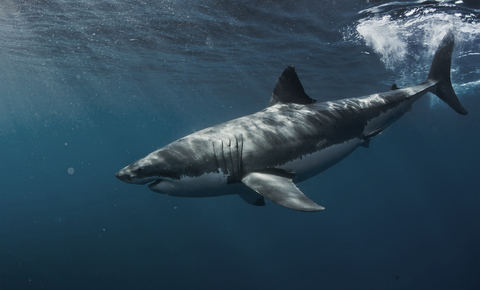

There are bad shark movies, and then there’s Great White — a film so over-the-top it managed to make Jaws look like a shark conservation documentary.
Released in 1981, this Italian-made Jaws knockoff, also known as The Last Shark, was so blatant that Universal Pictures had it pulled from U.S. theaters after a federal judge ruled it was far too close to Spielberg’s classic. Yet, over 40 years later, Great White (1981) remains a camp classic — a monument to cinematic audacity and shark-movie excess.

A Predator Born of Plagiarism
The early 1980s were the feeding frenzy years of shark cinema. Jaws and Jaws 2 had created a global obsession with dorsal fins and open-water terror. Director Enzo G. Castellari — best known for spaghetti westerns and war films like The Inglorious Bastards — decided to take a bite out of the craze himself.
He brought in American actors James Franciscus as a journalist (filling the Chief Brody role) and Vic Morrow as the grizzled shark hunter clearly modeled after Quint. Together they defend a seaside resort from a man-eating shark that’s threatening a local windsurfing competition.
Everything — from the beach-town politics to the fiery final showdown — mirrors Jaws so closely it borders on parody. When Universal’s lawyers saw the film, they didn’t laugh. They sued. By 1982, the film had been pulled from every American theater.
But rather than disappearing, Great White became legendary. The film that Hollywood tried to bury now survives as a pop-culture fossil — a piece of 1980s exploitation cinema that’s so bad it’s irresistible.

The Shark on the Poster
Even before you see a single frame, Great White tips its hand with its marketing. The movie poster — featuring a massive white shark lunging upward at a swimmer — is a near carbon copy of the Jaws one-sheet. But there’s another layer of theft at play.
That shark image looks suspiciously like one of Ron Taylor’s famous great white photographs. Taylor, along with his wife Valerie, was one of the world’s pioneering underwater filmmakers and shark conservationists. His images of great whites helped define how the public viewed these apex predators: powerful, graceful, and wild — not monsters.

By reworking one of Taylor’s visuals into cheap poster art, Great White managed to rip off both Hollywood and the natural world in a single stroke. It borrowed from real-life artistry to sell fake terror.
If Jaws was accused of vilifying sharks, Great White doubled down. Where Spielberg used suggestion and suspense, Castellari showed everything — rubber fins, puppet heads, and mismatched stock footage of real sharks stitched together like a cinematic Frankenstein.
In doing so, it turned one of Earth’s most awe-inspiring animals into a carnival attraction.
Camp in the Blood
What saves Great White (1981) from total disaster — and makes it unforgettable — is its camp value. The movie takes itself seriously, but the results are unintentionally hilarious.
Vic Morrow plays his role like he’s in a war film, barking orders and squinting through cigarette smoke. Franciscus looks perpetually confused, as though realizing mid-scene that he’s in an Italian exploitation movie. And then there’s the shark: a mix of stiff animatronics and grainy nature footage that changes size from shot to shot.
The special effects are primitive but earnest. One moment, the shark is a looming shadow beneath the surface; the next, it’s clearly a model head bouncing through foam. The infamous helicopter attack scene — where the shark leaps from the water to snag a low-flying chopper — remains one of the most laughably ambitious moments in shark cinema.
Everything about Great White is heightened: the melodrama, the dialogue, the swelling music that seems borrowed from a soap opera. The result isn’t just bad — it’s entertainingly bad, the kind of movie that makes you root for the filmmakers even as you cringe at the outcome.
Sharks and Sympathy
Over the years, I’ve spent plenty of time studying and writing about sharks — the real ones. And I can tell you, movies like Great White did them no favors.
If Jaws made people fear the ocean, Great White made them laugh at it — and sometimes, that’s worse. It turned great whites from majestic predators into comic-book villains. The irony is that in trying to outdo Jaws, the film actually highlights how careful Spielberg was in his storytelling.
Compared to Great White, Jaws feels almost reverent. Its shark, though terrifying, was treated like a natural force. Castellari’s beast, by contrast, is a blundering foam puppet whose only motivation seems to be bad timing.
But even bad art can teach good lessons. Watching Great White now, with what we know about shark conservation, it becomes a kind of time capsule — a reminder of how far we’ve come in understanding these animals. Great whites aren’t villains. They’re vital to the marine ecosystem. They control prey populations and keep oceans healthy.
In hindsight, the movie’s title feels ironic. The real “great white” was never the shark on screen — it was the one we were too afraid to understand.
The Fun of Failure
There’s something endearing about how hard Great White tries. It’s not cynical or self-aware like later “bad” shark films. It’s the genuine article: an Italian B-movie made with limited money, wild ambition, and absolutely no restraint.
That sincerity gives it heart. It’s why modern fans — especially collectors of camp horror and 1980s creature features — still talk about it today. Boutique labels have even reissued it under its alternate title The Last Shark, proudly proclaiming it “the movie Universal didn’t want you to see.”
And they’re right. It’s not scary. It’s not realistic. But it’s weirdly charming.
In Case You Missed Our Documentary on Great Whites in the Gulf Watch Here
What Lurks Beneath
If you’re building a Halloween movie lineup or a bad-shark marathon, Great White (1981) deserves a slot. It’s the cinematic definition of “so bad it’s good.” Every creative misstep becomes part of its personality.
You don’t watch this film for thrills. You watch it to see how far filmmakers will go when they smell blood in the water — in this case, the scent of Jaws’ success.
For shark fans, it’s also a fascinating study in how popular media shaped public opinion. Great White exploited fear without context. But the very fact that we can laugh at it now — and still appreciate sharks for what they truly are — shows how much cultural tide has turned toward conservation and understanding.
If Ron Taylor’s real-life photos showed the shark as noble and wild, Great White turned it into a plastic parody. Somewhere between the two lies the truth of our fascination: we fear what we don’t understand, and sometimes we even make movies about it.
Final Bite
In the end, Great White (1981) isn’t just a shark movie. It’s a pop-culture relic — a story about our obsession with fear, fame, and the creatures we mythologize to sell tickets.
It’s a mess. It’s a rip-off. But it’s also weirdly wonderful.

So this Halloween season, when you’re flipping through the streaming menu for your next bad shark flick, give this one a shot. You’ll laugh. You’ll groan. And if you’re like me, you’ll come away thinking about how sometimes even the worst movies tell us something real — about the wild, about ourselves, and about the blurry line between terror and admiration.
Because if Jaws made us afraid of the water, Great White made us realize just how silly that fear can be.
Get a Dark Outdoors® Decal!
It’s our 13 Days of Halloween promotion for Dark Outdoors® my award-winning podcast on true crime and terrifying encounters in the great outdoors.

Subscribe to the podcast on your favorite platform (Spotify, Apple Podcasts, etc) and send me an email to chester@chestermoore.com with your mailing address and you will get this decal.
Chester Moore
Follow Chester Moore and Higher Calling Wildlife® on the following social media platforms
@thechestermoore on Instagram
Higher Calling Wildlife on Facebook
Email Chester at chester@chestermoore.com.
Subscribe to the Dark Outdoors and Higher Calling Wildlife podcasts on all major podcasting platforms.


Leave a Reply