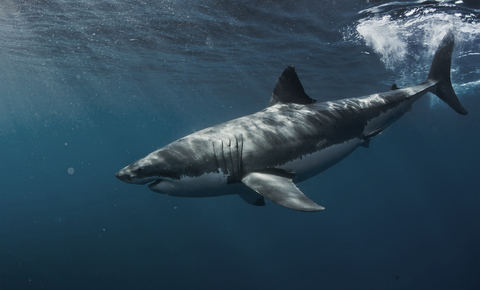

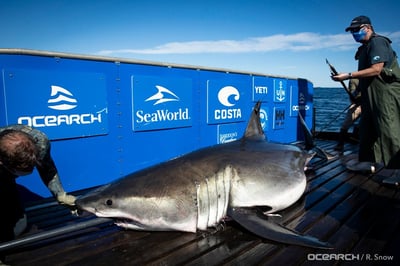
On May 15, 2025, OCEARCH broke new ground by tagging its first dusky shark — a female named Mira.
Although scientists have tracked dusky sharks (Carcharhinus obscurus) before, they have rarely captured public attention in the way more iconic shark species have. The release of “Mira,” complete with a spot tag broadcasting her movements, helps change that by opening a new window into the life of an often-overlooked predator and inviting the public to follow along in her story.

OCEARCH announced the event with excitement though a series of social media posts:
“Big news! We tagged our first dusky shark and she is live on the tracker! These coastal species were once overfished to the brink, but now we’re tracking one live for the first time on the free OCEARCH Global Shark Tracker App.”
OCEARCH Chief Scientist Harley Newton emphasized the milestone:
“Dusky sharks are globally endangered and are one of the most threatened coastal and pelagic species with population declines between 75% and 99% depending on region due to targeted fisheries and bycatch. This species does spend a significant amount of time below the surface so it will be interesting to see how often Mira sends us locations on the tracker. Monitoring dusky shark movements will help us better understand their habitat use and its overlap with commercial fisheries.”

Built Like A Brick House
Dusky sharks are among the largest members of the requiem shark family. Adults commonly measure 10 to 12 feet (3.2 to 3.6 meters) and weigh 350 to 750 pounds. Scientific reports document individuals reaching up to 14 feet (4.2 meters) in length, and some estimates suggest maximum weights near 880 pounds (400 kilograms). This places them among the heaviest-bodied coastal sharks, rivaling tiger sharks in size.
Their build is thick and muscular, designed for long-distance swimming. The back is slate-gray to dusky brown, fading into pale sides and a whitish underside.
At first glance, duskies resemble several other species — particularly sandbar sharks and silky sharks. Sandbars are stockier with taller first dorsal fins, while silkies are slimmer with longer pectorals. Duskies fall in between: broad-bodied but sleek, with a relatively low, rounded first dorsal fin. A subtle ridge between the dorsal fins can also help with identification.
Life at a Slow Pace
Duskies exemplify the vulnerability of large sharks. They grow slowly, often not reaching maturity until 18 to 20 years of age. Females endure one of the longest pregnancies in the animal world (about 22 months ) and give birth only every two to three years. Litters are small, usually six to twelve pups.
Because of these traits, dusky populations cannot rebound quickly. When heavy fishing pressure in the mid-to-late 20th century caused declines of more than half in U.S. waters, recovery slowed to a crawl. Even with a federal ban on targeted harvest enacted in 2000, bycatch mortality in longline and net fisheries continues to be a concern.
The International Union for Conservation of Nature currently lists the dusky shark as endangered. Scientists warn that even under the strictest protections, full recovery in the western Atlantic may take 70 years.
Mira: A First of Her Kind
Mira represented a milestone because duskies had been largely absent from major tagging initiatives until then. At the time of tagging, she measured 9 feet 8 inches (2.95 meters) and weighed 327 pounds (148 kilograms), just above the known maturity threshold for females.

John Tyminski Senior Data Scientist at OCEARCH, highlighted just how rare this was.
“Mira, our first dusky shark to be spot-tagged, marks a really important moment. Working off the Florida–Georgia border we’ve been finding some interesting things, including duskies. We don’t want to draw conclusions yet by any means, but it was exciting to see. And Mira’s been pinging in pretty well — right now she’s showing up off Cape Cod.”
His cautious optimism reflects both the excitement of the tagging milestone and the uncertainty that still surrounds the species’ recovery
Tracking Mira and Other Sharks
Mira can be followed in real time on the OCEARCH Global Shark Tracker, alongside hundreds of other tagged sharks from species such as great whites, tigers, and makos. The tracker allows the public and scientists alike to see where sharks travel, how they use different habitats, and when they make surprising long-distance migrations.
Because dusky sharks often spend much of their time below the surface, Mira’s signals may be less frequent than those of surface-oriented species. Each ping, however, provides invaluable data that helps scientists better understand habitat use and overlap with fisheries.
You can track Mira and other sharks directly at: https://www.ocearch.org/tracker
A Species Worth Watching
Mira’s signals represent more than the track of a single shark. They represent a shift: dusky sharks, once almost absent from research, are now finally being studied with modern tools. Each ping offers a chance to understand where they go, how they use the Gulf and Atlantic seaboard, and what hazards they encounter.
Their survival matters beyond scientific curiosity. As apex predators, duskies regulate prey populations and help keep marine food webs balanced. Their decline left gaps in ecosystems; their recovery could restore stability.
But their future is precarious. Slow reproduction, susceptibility to bycatch, and shifting oceans mean that every dusky shark counts. Mira’s journey is a reminder that while the species teeters on the edge, it still endures — and with careful protection, it may yet return in far more significant numbers.
Chester Moore
Follow Chester Moore and Higher Calling Wildlife® on the following social media platforms
@thechestermoore on Instagram
Higher Calling Wildlife on Facebook
Email Chester at chester@chestermoore.com.
Subscribe to the Dark Outdoors and Higher Calling Wildlife podcasts on all major podcasting platforms.




Leave a Reply