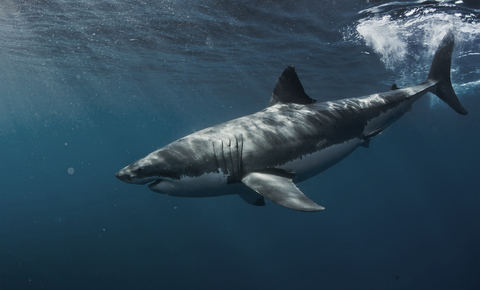

Two years ago today (Dec. 8), “LeeBeth” the great white shark history as set in motion.
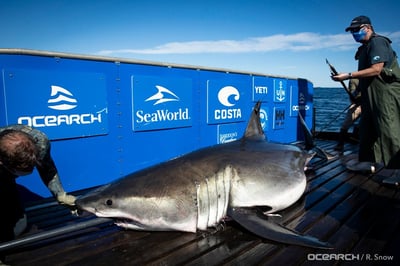
Capt. Chip Michalove of Outcast Sportfishing and Megan Winton of the Atlantic White Shark Conservancy put a series of tags including a satellite tag in a 14.5 foot great white shark female off the coast of South Carolina.
Nicknamed after a young lady who passed away, the shark made an impact journey recorded on AWSC’s “Sharktivity” app and popped up Feb. 2024 about 100 yards from the beach at South Padre Island, TX.
That detection wasn’t just another point on a map. It was a genuine milestone in modern shark research.

A Shark With a Story—and a Purpose
The decision to use the name LeeBeth wasn’t made to dramatize her, but to give researchers and the public a consistent and respectful identifier.
A shark with a human name allows readers to follow complex data in a relatable way while honoring the memory tied to the name. In wildlife journalism, that matters. It builds a bridge between raw science and community understanding, especially when dealing with an animal as culturally loaded as the great white shark.
From the moment she was tagged, LeeBeth occupied that uniquely effective space—part scientific asset, part educational symbol, part reminder of how much we still don’t know.
In case you haven’t seen it yet check out our Gulf Great White Sharks: Return of an Icon documentary.
Tracing LeeBeth’s Journey
After her tagging in December 2023, LeeBeth did what most acoustically and satellite-tagged white sharks do: she moved. But it was where she moved that elevated her from “interesting data point” to “Gulf ambassador.”
Her path took her down the Atlantic coast, threading through waters where great white telemetry is well-established. Each ping fed into Sharktivity, painting a picture of a typical winter migration—until February, when she made an historic push into the Gulf.
Then came the ping off Texas, near South Padre Island. Not offshore. Not deep.
But close—shockingly close—to the beach, offering the clearest, verifiable evidence yet that large female great whites not only enter the Gulf, but move all the way across to the Texas Coast and even into the waters of Mexico.
Later transmissions placed her along Florida’s Gulf Coast, then eventually back into the chilly waters of Nova Scotia.
Why Her Tagging Mattered
Tagging programs, whether satellite, acoustic, or accelerometer-based, are the backbone of modern shark research. Tagging turns guesses into maps, anecdotes into evidence, and assumptions into testable hypotheses.
LeeBeth’s tag:
- Confirmed that female great whites of significant size enter the Gulf.
- Demonstrated that at least one used nearshore Texas waters.
- Helped refine models of seasonal movement between the Atlantic and Gulf.
- Elevated public understanding of shark behavior without the sensationalism that too often accompanies the species.
For Gulf researchers, managers, anglers, and coastal communities, the value of that single shark cannot be overstated. She filled gaps that previously left the region’s great white story incomplete.
Click to read about her appearance last November-after her satellite tag quit working.
Exclamation Point On Other Gulf White Shark Activity
LeeBeth wasn’t the first great white to show up in the Gulf. Ocearch has had numerous show up including one that pinged about 120 miles off of Galveston, TX in 2021.. But her journey to South Padre, presence right off the beach and jaunt into Mexico were impressive.
In my opinion, it just put more of a spotlight on all great white research and Ocearch and others involved out there certainly deserve a huge tip of that. They are all doing great work.
A Legacy in Motion
Even after her satellite tag eventually went silent, LeeBeth’s influence continued. She provided the kind of baseline movement data that future Gulf detections will be measured against. She set a standard for what is possible—and what researchers should continue to watch for.
In a region where shark histories have often been written in fragments, LeeBeth helped complete the picture.
She didn’t just swim from South Carolina to Texas. She swam into the center of an ongoing scientific story—one that is still unfolding with every new tag and every new question about how great whites interact with Gulf ecosystems.
And in doing so, she became exactly what the Gulf needed: a shark whose journey brought understanding, attention, and meaningful research into the spotlight.
Chester Moore
Follow Chester Moore and Higher Calling Wildlife® on the following social media platforms
@thechestermoore on Instagram
Higher Calling Wildlife on Facebook
Email Chester at chester@chestermoore.com.
Subscribe to the Dark Outdoors and Higher Calling Wildlife podcasts on all major podcasting platforms.



Leave a Reply