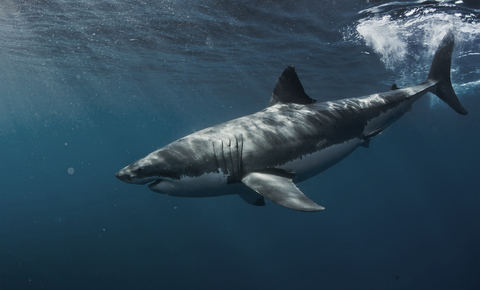

Jacques Cousteau, the legendary French oceanographer, filmmaker, and explorer, dedicated his life to unlocking the mysteries of the ocean depths. Among his many expeditions and discoveries, Cousteau’s work on great white sharks stands out as a testament to his passion for understanding and protecting marine life.
Great white sharks, with their imposing size and fearsome reputation, have long captivated the human imagination. For Cousteau, these apex predators represented both a scientific enigma and a symbol of the fragile balance of life in the ocean.
In the 1970s, Cousteau embarked on a series of expeditions to study great white sharks in their natural habitat. Armed with his iconic vessel, the Calypso, and a team of dedicated researchers and filmmakers, Cousteau set out to explore the remote waters where these elusive creatures roam.

One of Cousteau’s most notable encounters with great white sharks occurred off the coast of South Africa, where he and his team ventured into the waters of Seal Island, a known hotspot for shark activity. Using underwater cameras and diving equipment, Cousteau captured rare footage of great white sharks hunting seals with astonishing speed and precision.
Cousteau’s observations shed new light on the behavior and ecology of great white sharks, revealing their role as top predators in marine ecosystems. Through his groundbreaking documentaries, including “The Shark: Splendid Savage of the Sea,” Cousteau introduced millions of viewers to the awe-inspiring world of these magnificent creatures.
But Cousteau’s work went beyond mere observation; it also had a profound impact on our understanding of human-shark interactions. By debunking myths and misconceptions surrounding great white sharks, Cousteau sought to dispel the fear and hostility often directed towards these misunderstood predators.
In particular, Cousteau emphasized the importance of conservation efforts to protect great white sharks and their habitats. He warned of the dangers posed by overfishing and habitat destruction, which threaten to push these iconic predators to the brink of extinction.
Today, Cousteau’s legacy lives on in the ongoing efforts to study and conserve great white sharks. Scientists continue to build on his pioneering work, using advanced technology and research techniques to unlock the secrets of these elusive creatures.

In recent years, initiatives such as shark tagging programs and marine protected areas have helped to safeguard great white shark populations and promote coexistence between humans and sharks. By raising awareness and advocating for conservation, Cousteau’s work has inspired a new generation of ocean stewards to protect the world’s oceans for future generations.
As we continue to unravel the mysteries of the deep, Jacques Cousteau’s legacy serves as a reminder of the profound impact that one individual can have on our understanding and appreciation of the natural world. In the case of great white sharks, his pioneering work has paved the way for a deeper appreciation of these majestic creatures and the vital role they play in maintaining the health of our oceans.
Cousteau was a big influence on my life and I wear a beanie during cool weather in honor of him.
I’m not a cool French guy so I can’t pull off the red but mine is black, more befitting a guy that played in metal bands.
Jacques Cousteau will never be forgotten.
Chester Moore
Follow Chester Moore and Higher Calling Wildlife® on the following social media platforms
@thechestermoore on Instagram
Higher Calling Wildlife on Facebook
Email Chester at chester@chestermoore.com.
Subscribe to the Dark Outdoors and Higher Calling Wildlife podcasts on all major podcasting platforms.



Leave a Reply