There are some conversations that remind you just how much there is left to learn about the wild world.
I had one of those in New Bedford, Massachusetts, sitting in the office of Dr. Greg Skomal and talking about sharks for nearly two hours.
My wife Lisa, daughter Faith and Marina Wilson were there with me as part of our New England shark expedition. We had already experienced some incredible things on the trip, but getting the opportunity to slow down and simply talk sharks with one of the world’s leading great white researchers was something special.
I first got connected with Greg a couple of years ago through our friends at the Atlantic White Shark Conservancy and later interviewed him for our documentary work. Greg is the Large Pelagics and Diadromous Fisheries Program Manager for the Massachusetts Division of Marine Fisheries, leads its shark research efforts and is the author of Chasing Shadows: My Life Tracking the Great White Shark.
I consider him a shark conservation hero.

But Greg isn’t simply someone who has been around shark research for a long time. He’s on the cutting edge of it, actively involved in research that is changing what we know about great whites and how scientists can study these incredible animals.
That’s what made our conversation so fascinating.
We started by talking about where modern shark research came from. Names like Dr. Eugenie Clark and Dr. Samuel “Doc” Gruber came up, two pioneers who helped change the way scientists—and ultimately the public—looked at sharks.
Clark, famously known as the “Shark Lady,” conducted groundbreaking research into shark behavior and demonstrated that these animals were far more complex than the mindless eating machines they were often portrayed to be. Gruber devoted much of his career to understanding shark biology and behavior and founded the Bimini Biological Field Station Foundation’s Shark Lab in the Bahamas.

Those researchers helped establish a foundation.
Then our conversation moved into where shark research is going now.
That’s where Greg’s work gets really interesting.
We talked at length about what it’s actually like to tag a great white shark from a boat. Most people today have seen shark tracking maps. A shark shows up as a dot on a screen, and we can follow its movements up and down the coast.
But there is a story behind how that dot gets there.
Greg described the process of getting close enough to a free-swimming great white to deploy research equipment. Spotter aircraft have been used to locate sharks and guide research vessels into position, and Greg has spent countless hours on the water putting himself within tagging range of one of the most powerful predators on the planet.
I’ve seen the footage of Greg standing out on the pulpit of a research vessel with a great white moving through the water below him. That’s a long way from sitting behind a computer looking at tracking data.
And the technology being deployed continues to evolve.
Researchers are using acoustic telemetry, satellite-linked tags, cameras and sophisticated data-logging equipment to investigate not only where sharks travel but what they’re actually doing beneath the surface. Some tags can gather incredibly detailed information about an animal’s movements, including swimming depth, acceleration and body position.
That fascinates me.
For most of human history, when a great white disappeared beneath the surface, it essentially disappeared from our world.
Now scientists are finding ways to follow it into its own.
And that led us into another part of the conversation that I found particularly encouraging.
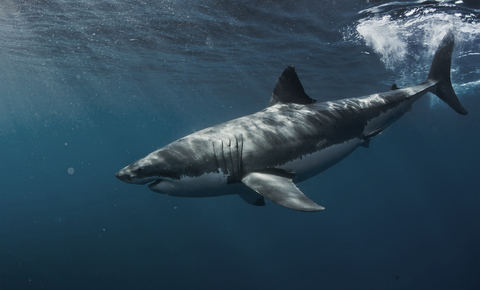
Great white sharks appear to be making a comeback in the western North Atlantic.
These animals were heavily impacted by fishing pressure during the latter part of the 20th century. Great whites received federal protection from harvest in U.S. waters in 1997, with Massachusetts later adding its own protections.
Today, the evidence points toward a recovering population.
Greg talked about that as one of the bright spots in conservation. Protections were put into place, and there are encouraging signs they’re working.
I love hearing that.
Those of us involved in wildlife conservation spend a lot of time talking about animals in trouble. Habitat disappears. Populations decline. Problems arise that don’t have simple solutions.
Sometimes we need to acknowledge the victories, too.
Seeing great whites return to portions of their historic range is a good thing.
But recovery doesn’t mean the work is finished. In many ways, it gives scientists an entirely new set of questions to answer.
Where are these sharks going throughout their lives? What habitats are most important to them? What are they doing when they reach particular areas? How do they hunt? How do environmental conditions influence their movements? And in places such as Cape Cod, where large numbers of people and great whites can occupy the same coastal waters, how do we learn enough about shark behavior to help people coexist with them?
There is still a tremendous amount we don’t know.
That’s why the work Greg is doing with the Massachusetts Division of Marine Fisheries, much of it in collaboration with the Atlantic White Shark Conservancy, is so exciting.
And sitting there listening to all of this was Marina.
That was one of my favorite parts of the entire experience.
Marina didn’t get a five-minute meet-and-greet with a famous shark scientist and take a picture before moving along. She got to sit there and ask questions. We talked about where shark research came from, what researchers can do today and what the future might hold.
That’s the kind of experience that can light a fire in a young person.
Then Greg did something none of us expected.
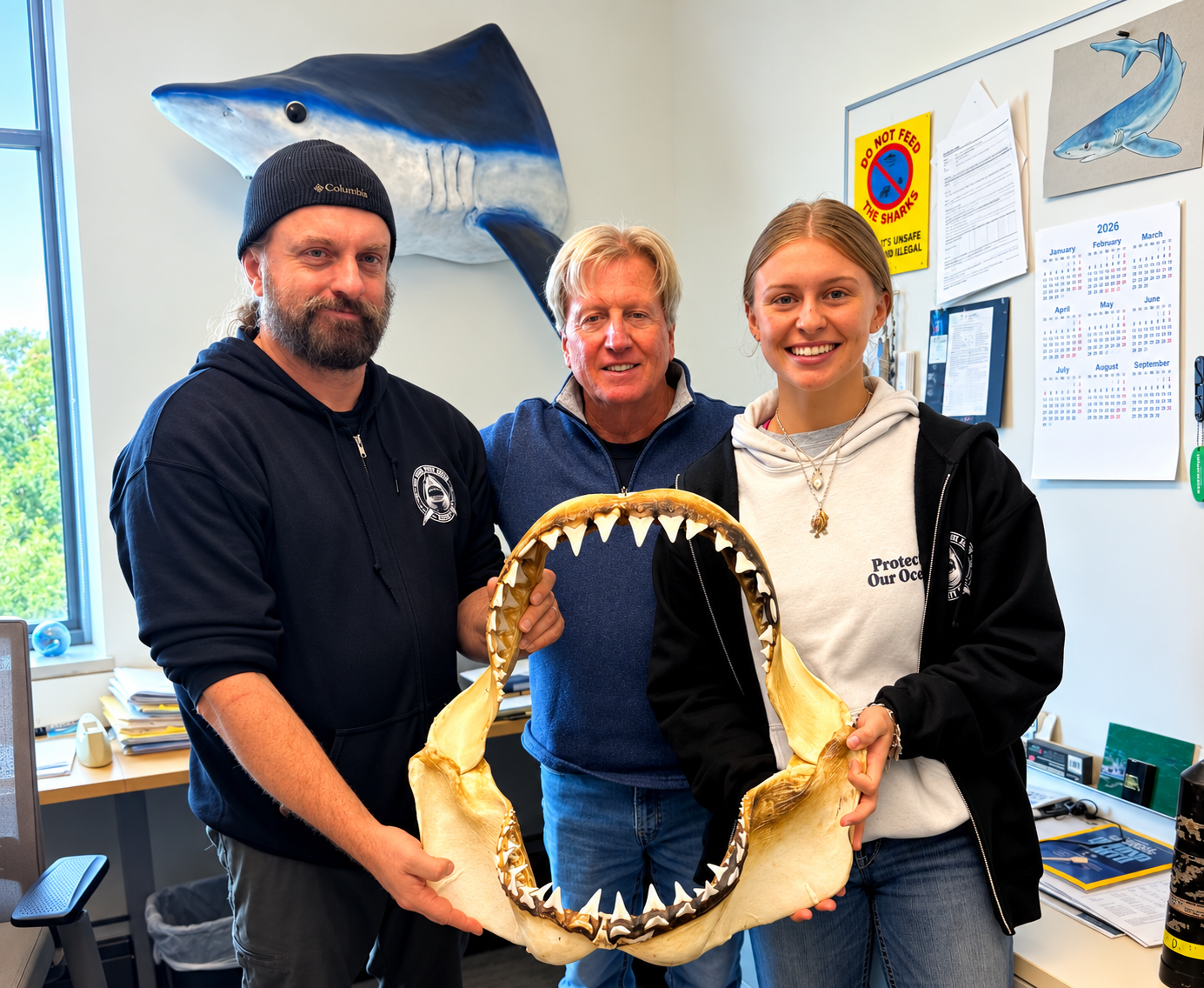
In his office was the preserved jaw from a roughly 12-foot great white shark that had washed ashore dead years ago. We didn’t ask him if we could hold it. We didn’t even hint around about it.
Greg just got it out and let us hold it.
That’s Greg. He’s a good dude.
Standing there with Marina and Greg holding those enormous jaws after everything we had just discussed struck me in a way I wasn’t expecting.
For generations, shark jaws were often displayed primarily as trophies, symbols of an animal conquered or something terrifying pulled from the sea.
Here we were holding the jaws of a great white in a fisheries research office after spending nearly two hours discussing telemetry, tagging, behavior, migration, conservation and some of the most advanced shark research happening anywhere.
The shark hasn’t changed.
Our understanding of it has.
From Eugenie Clark and Doc Gruber asking some of the foundational questions about what sharks really are to researchers like Greg standing on the bow of a boat deploying sophisticated technology on a free-swimming great white, each generation has pushed that understanding a little farther.
And Greg is pushing it right now.
That’s an important distinction because this isn’t simply a story about the history of shark research. Some of the most exciting chapters are being written today.
I’m grateful to Dr. Greg Skomal for opening his office to my family and Marina, answering a ridiculous number of shark questions and sharing his knowledge with a young person who has a genuine passion for these animals.
I’m also thankful for everyone who supports what we do and helped make this expedition possible. One of our goals is to put young people in situations where wildlife isn’t simply something they see on a screen. They get to meet the scientists, researchers and conservationists actually doing the work.
We’re also hoping what happened on this trip can help us establish something new that will create more opportunities for young people in Massachusetts. There will be more on that later.
For now, I’m encouraged.
Great white sharks appear to be writing one of the brighter conservation comeback stories in American waters. Protections appear to be working, the sharks are returning and researchers have tools previous generations could hardly have imagined.
But there are still plenty of mysteries swimming beneath the surface.
After nearly two hours talking sharks with Greg Skomal, I came away more excited than ever about finding the answers.
And somewhere out there is a young person who will take what Greg and today’s researchers are learning and push it even farther.
Maybe that’s the most exciting part of the story.
Chester Moore
Follow Chester Moore and Higher Calling Wildlife® on the following social media platforms
@gulfgreatwhitesharksociety on Instagram
@thechestermoore on Instagram
Higher Calling Wildlife on Facebook
Email Chester at chester@chestermoore.com.
Subscribe to the Dark Outdoors podcast on all major podcasting platforms.



Leave a Reply