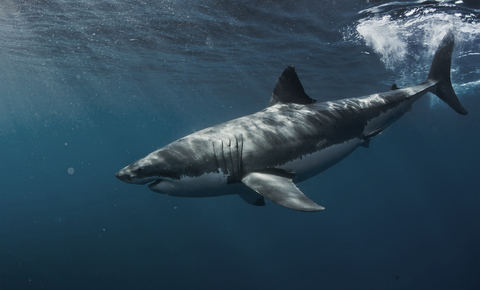

As millions of viewers tune in to Shark Week to watch great white sharks patrol the waters off Nova Scotia and the Gulf of St. Lawrence, many may not realize those same sharks were swimming in the Gulf of Mexico only a few months ago.
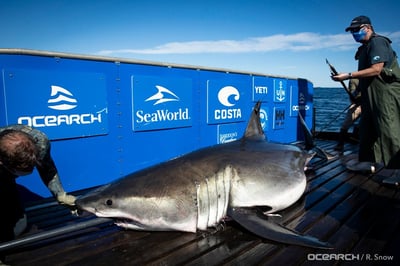
According to OCEARCH Chief Data Scientist John Tyminski, several of the satellite-tagged great white sharks currently appearing on the organization’s Shark Tracker have completed their annual migration back to Atlantic Canada after spending the winter in Gulf waters.
The movement is more than an impressive long-distance journey. It provides another glimpse into one of the defining behaviors of mature North Atlantic great white sharks: site fidelity.
“Most of the white sharks currently on Shark Tracker, tagged in collaboration with the Tancook Islands Marine Field Station, are back in Atlantic Canada where we tagged them last summer/fall,” Tyminski said.
“We’ve got Brookes in the Bay of Fundy, Quint and Ripple off Cape Breton, as well as Bella and Cross in the Gulf of St. Lawrence, to name a few. Many of these same sharks were in the Gulf of Mexico just a few months ago during the overwintering period.”
Tyminski said the return to these northern waters is not unusual.
“It’s not uncommon for these white sharks to show site fidelity—returning to the exact same area they visited in years prior,” he said.

“We believe these sharks learn from their experience and return to areas where they previously foraged successfully.”
While Tyminski’s comments specifically address the sharks’ return to Atlantic Canada’s productive feeding grounds, their documented seasonal movements also reveal another intriguing pattern. Many of these same individuals have been tracked into the Gulf of Mexico during the winter before returning north in the spring, and several have repeated that cycle over multiple years.
Although scientists continue to study exactly what drives these migrations, the tracking data suggest that mature great white sharks may exhibit a broader pattern of seasonal fidelity—returning not only to established summer feeding areas in Atlantic Canada but also to important winter habitat in the Gulf of Mexico.
That distinction is significant.
For decades, the Gulf was often viewed as a place where great white sharks occasionally appeared. Today, satellite tracking paints a different picture. The Gulf is increasingly recognized as an important seasonal destination for mature North Atlantic great whites, particularly during the overwintering period before they begin their migration north.
The journey itself is one of the most remarkable migrations in the marine world. Traveling more than 2,000 miles, these sharks move between the warm waters of the Gulf of Mexico and the rich feeding grounds of Atlantic Canada, timing their movements with seasonal changes in water temperature and prey availability.

Each year, the pattern becomes a little clearer.
As additional sharks are tagged and tracked, researchers continue to document individuals making the same seasonal movements between the Gulf and Atlantic Canada. Those repeated migrations strengthen our understanding that these two regions are connected by a predictable annual cycle rather than isolated shark encounters.
For those of us following great white sharks in the Gulf, that’s one of the most exciting developments in recent years. The Gulf is proving to be more than a waypoint on a long journey. It appears to be an important part of the annual lives of these apex predators, connected to the same remarkable instinct that brings them back to Canada’s waters year after year.
As Shark Week showcases these magnificent sharks off Nova Scotia, Cape Breton, the Bay of Fundy, and the Gulf of St. Lawrence, it’s worth remembering that many of those same animals spent the winter months in the Gulf of Mexico. Their annual return north highlights the remarkable site fidelity that has long fascinated researchers and further illustrates the Gulf’s growing importance in understanding the full life cycle of North Atlantic great white sharks.
Chester Moore
Follow Chester Moore and Higher Calling Wildlife® on the following social media platforms
@gulfgreatwhitesharksociety on Instagram
@thechestermoore on Instagram
Higher Calling Wildlife on Facebook
Email Chester at chester@chestermoore.com.
Subscribe to the Dark Outdoors podcast on all major podcasting platforms.


Leave a Reply