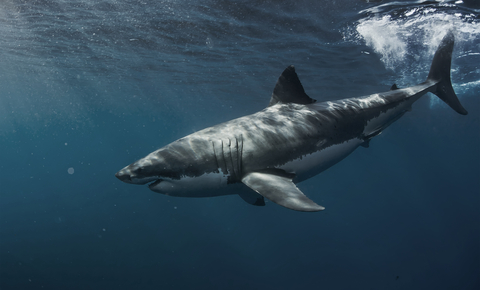
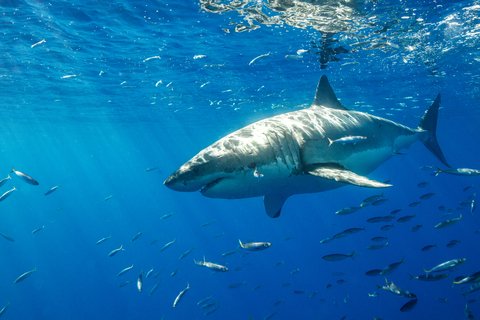
Every July, millions of Americans tune in for Shark Week. They watch massive great white sharks explode from the waters off South Africa, patrol the seal colonies of Cape Cod, or cruise the Pacific Coast. These spectacular images have shaped how generations of people think about the world’s most famous predator. Ask the average person where great white sharks live and you’ll almost certainly hear the same places mentioned: California, Massachusetts, Australia and South Africa.
Few people will say the Gulf of Mexico.
That omission is understandable. For decades, the Gulf was treated as an afterthought in the story of great white sharks. Scientific literature acknowledged occasional records, fishermen occasionally landed one by accident, and every few years a sighting would make local headlines before fading into obscurity. Even many experienced anglers who spent thousands of hours offshore never expected to encounter one. The prevailing belief was simple: if a great white showed up in Gulf waters, it was an exception rather than part of a larger pattern.
Today, we know that story was incomplete.

One of the biggest discoveries in modern shark science isn’t happening off Cape Cod or California. It has unfolded quietly in the Gulf of Mexico through satellite tracking, acoustic detections, historical research and decades of observations that were often overlooked because no one connected the dots. Those pieces now fit together in a way they never have before, revealing that the Gulf is far more important to great white sharks than most scientists—or the public—once imagined.
This isn’t merely a story about sharks.
It’s a story about how science evolves, how old assumptions can be overturned and how one of the ocean’s greatest predators has been quietly rewriting its own field guide right under our noses.
Looking Beyond the Headlines
I’ve spent much of my career chasing wildlife stories that fall outside conventional wisdom. Sometimes those investigations involve rare species appearing where no one expects them. Other times they center on animals whose importance has been underestimated because the evidence remained scattered across decades and thousands of miles.
Great white sharks in the Gulf belong firmly in that second category.
Long before satellite tags transformed shark research, I became fascinated by reports of great white sharks from Gulf waters. At first, they seemed disconnected. One old newspaper described commercial fishermen landing an enormous white shark. Another account came from offshore oil workers who watched a huge shark circle beneath their platform. Divers occasionally described unmistakable encounters. Fisheries reports documented specimens that rarely found their way into popular books about sharks.
Individually, none of these reports proved much. Eyewitnesses can make mistakes. Memories fade. Stories grow larger with time. Wildlife history is filled with cases where extraordinary claims eventually collapsed under closer examination.
But it is also filled with discoveries that began with someone taking seemingly unrelated observations seriously.
As more records surfaced, a pattern began to emerge. The reports stretched from Texas to Florida. They spanned generations instead of a few isolated years. Many came from experienced commercial fishermen or offshore workers who knew the difference between a bull shark, a tiger shark and a great white. Others included photographs, specimens or documentation that removed much of the uncertainty.
The evidence wasn’t pointing toward random accidents.
It was pointing toward a recurring presence.
That realization eventually led to the creation of the Gulf Great White Shark Society Sightings Database, an ongoing effort to collect, verify and organize historical and modern records from throughout Gulf waters. The project continues to grow as new reports are documented, but even its earliest versions revealed something remarkable. Rather than finding a handful of isolated encounters, the database uncovered a long history of credible records dating back nearly a century.
Historic reports include commercial catches from Florida, documented encounters off the Texas coast, records associated with Louisiana’s offshore waters and observations from Alabama and Mississippi. More recent entries include drone footage, underwater video, offshore encounters and scientifically documented sharks whose movements have fundamentally changed how researchers view the Gulf.
Taken together, these records tell a story that no single sighting ever could.
Great white sharks have been part of the Gulf ecosystem far longer than most people realized.
Science Begins Catching Up
Historical records provided intriguing clues, but modern technology supplied the evidence many scientists had been waiting for.
Satellite tagging revolutionized shark research by allowing scientists to follow individual animals across thousands of miles of open ocean. Instead of relying on chance encounters, researchers could observe migration routes, seasonal movements and habitat use in real time. Every new tag added another chapter to a story that had remained largely invisible beneath the surface.
As those tracks accumulated, one pattern became impossible to ignore.
Many mature great white sharks weren’t simply traveling along the Atlantic Coast. They were entering the Gulf of Mexico during their seasonal migrations.

The significance of those movements became even clearer through research involving OCEARCH and collaborating scientists. Analysis of 92 tagged western North Atlantic great white sharks found that 57 entered the Gulf of Mexico or the Straits of Florida during their annual movements. Rather than representing a few unusual individuals, the data suggested that the Gulf serves as an important seasonal destination for a substantial portion of the western North Atlantic population.
That finding represented far more than an interesting statistic.
It challenged decades of assumptions about where great white sharks spend part of their lives and elevated the Gulf from a peripheral footnote to an important chapter in the biology of one of the world’s most recognizable predators.
The Gulf wasn’t simply a place where an occasional shark wandered.
It was becoming clear that it was part of the annual cycle of many of these animals.
Then Came LeeBeth
While broad scientific studies often reshape our understanding, individual animals sometimes capture the public imagination in ways that research papers never can.
For the Gulf of Mexico, no shark has done that more effectively than LeeBeth.
Tagged by researchers with the Atlantic White Shark Conservancy in partnership with veteran shark fisherman Capt. Chip Michalove off South Carolina in December 2023, LeeBeth quickly became one of the most closely watched great white sharks in North America. Like many tagged sharks before her, she initially appeared to be following expected seasonal movements.

Then her track took an extraordinary turn.
As winter progressed, LeeBeth continued moving southwest until she entered the Gulf of Mexico. Eventually, she reached waters off South Padre Island, Texas, representing one of the westernmost documented movements of a satellite-tagged great white shark in the region. Later, an acoustic detection near South Padre Island confirmed her presence in Texas waters even after her satellite transmitter stopped reporting.
For many people, LeeBeth’s journey was their first realization that great white sharks don’t simply skirt the eastern edge of the Gulf before turning back into the Atlantic.
They can travel deep into Gulf waters.
Her remarkable migration also illustrated something larger. The Gulf is not isolated from the Atlantic ecosystem. It is part of it. Great white sharks move freely between these waters, following ancient migratory routes that existed long before humans ever began placing satellite tags on sharks.
Yet as remarkable as LeeBeth’s journey was, it didn’t create a new phenomenon.
It simply gave modern science—and the public—a front-row seat to one that had likely been occurring for generations.
LeeBeth’s journey captivated the public because it was visible. Anyone following her track could watch the migration unfold in near real time, and when she reached the western Gulf, thousands of people suddenly realized that great white sharks were using waters they had never associated with the species. But LeeBeth was never the whole story. She simply became the most recognizable ambassador for a much larger body of evidence that had been building for decades.
In fact, one of the most fascinating aspects of this story is that satellite tracking has largely confirmed what many commercial fishermen, offshore workers and seasoned Gulf captains had been saying for years.
The Gulf Great White Shark Society Sightings Database was created to preserve those accounts and place them into context. Rather than focusing on rumors or sensational claims, the database emphasizes documented reports that can be traced to newspaper archives, fisheries records, photographs, scientific publications or credible firsthand witnesses. It continues to grow as new information is uncovered, but even now it paints a picture that is difficult to ignore.
The oldest records date back nearly a century, demonstrating that great white sharks have been encountered in Gulf waters for generations. Historical commercial catches from Florida, documented records from Texas, offshore observations in Louisiana waters and numerous reports from the northern Gulf all point toward the same conclusion. These sharks were never entirely absent. We simply lacked the tools to understand how they fit into the larger population.
One of the recurring themes in the database is that many encounters occur far from crowded beaches. Offshore oil platforms, shrimp boats, commercial fishing operations and deep-water recreational trips account for a surprising number of reports. That makes perfect sense when you consider the ecology of great white sharks. Mature whites spend much of their lives in offshore environments, moving across vast expanses of ocean in search of prey rather than hugging coastlines where most people spend their time.
This reality also helps explain why the Gulf remained overlooked for so long. Most people judge shark distribution by what they see near beaches. Great white sharks don’t operate that way.
Texas provides an excellent example.
Despite having hundreds of miles of coastline, verified great white encounters are relatively uncommon compared to more frequently encountered species like bull sharks, tiger sharks or hammerheads. Yet uncommon does not mean nonexistent. Historical captures near Port Aransas, offshore encounters reported by experienced oilfield workers, observations around the Flower Garden Banks National Marine Sanctuary and LeeBeth’s remarkable journey to South Padre Island all demonstrate that Texas is very much part of the great white story.
The Flower Garden Banks deserve particular attention. Rising from deep Gulf waters roughly 100 miles offshore, these reefs support an extraordinary diversity of marine life. They also sit within waters capable of supporting highly migratory predators. Several credible observations of great white sharks have come from this region over the years, reinforcing the idea that offshore Gulf habitats play an important role that most coastal residents never see.
Farther east, the database reveals another interesting pattern. Florida’s Panhandle has produced an impressive number of modern observations, particularly around Pensacola, Navarre Beach, Destin and Panama City. Drone footage, underwater photography, angler encounters and verified observations have documented great whites in waters that many vacationers assume belong exclusively to smaller coastal sharks.
Louisiana contributes another important chapter. Offshore platforms have long provided habitat for countless marine species, and workers stationed on these structures have occasionally reported seeing unmistakable great white sharks. The nearby Chandeleur Islands have also produced notable records through the years, adding another piece to the Gulf-wide puzzle.
When viewed individually, these reports might seem like isolated curiosities. Viewed together, they reveal a striking consistency stretching across decades and across nearly every Gulf state.
That consistency matters.
Wildlife science rarely advances because of a single spectacular event. Instead, it progresses as independent lines of evidence begin pointing toward the same conclusion. Historical records, satellite tracking, acoustic detections, verified photographs and recurring observations now reinforce one another in ways they simply couldn’t twenty years ago.
One misconception still persists, however. Some people assume that acknowledging great white sharks in the Gulf means claiming they are common.
Nothing could be further from the truth.
Great white sharks remain relatively rare throughout Gulf waters compared to species like bull sharks, blacktips, spinner sharks and tiger sharks. The average beachgoer is extraordinarily unlikely to ever see one, much less encounter one in the water. Their rarity is precisely why individual records attracted so much attention for decades.
But rarity and absence are not the same thing.
That distinction may be the most important lesson this entire story has to offer.
For years, “rare” slowly became interpreted as “they don’t really live here.” Modern science has demonstrated that assumption was overly simplistic. Great whites may not be abundant in the Gulf, but evidence increasingly shows that the Gulf forms an important part of the annual range for many western North Atlantic sharks.
That realization carries important conservation implications.
Every ecosystem used by a migratory species matters. If mature great white sharks spend part of each year in Gulf waters, then the health of those waters becomes part of the health of the broader western North Atlantic population. Water quality, prey availability, fisheries management and offshore habitat all become pieces of a much larger conservation picture.
It also reminds us that nature rarely conforms to the boundaries humans place on maps.
The Gulf of Mexico and the Atlantic Ocean are not separate worlds. They are connected by currents, migrations and ecological relationships that have existed for thousands of years. Great white sharks have almost certainly been making these seasonal journeys long before anyone imagined following one by satellite.
Perhaps that is what I find most fascinating about this story.
In an age when it seems every corner of the natural world has been explored, one of Earth’s largest predatory fish has quietly forced us to rethink what we thought we knew. The discovery wasn’t made because the sharks suddenly changed their behavior. It happened because science finally developed the tools to watch them closely enough.
For those of us who have spent years documenting Gulf encounters, that validation has been immensely satisfying. The historical records, fishermen’s stories and forgotten reports were never the final answer, but they contained important clues. Today those clues are supported by satellite tracks, acoustic detections and peer-reviewed research that collectively paint the clearest picture we’ve ever had of great white sharks in Gulf waters.
Every Shark Week, millions of people marvel at great whites breaching off distant shores. Those images deserve their place because they showcase one of nature’s most spectacular predators. But perhaps the greatest shark story isn’t happening in front of television cameras. It is unfolding in waters bordered by Texas, Louisiana, Mississippi, Alabama and Florida, where decades of research are reshaping our understanding of one of the ocean’s most iconic animals.
The Gulf of Mexico is no longer a footnote in the story of the great white shark.
It is one of the places where that story is still being written.
Chester Moore
Follow Chester Moore and Higher Calling Wildlife® on the following social media platforms
@gulfgreatwhitesharksociety on Instagram
@thechestermoore on Instagram
Higher Calling Wildlife on Facebook
Email Chester at chester@chestermoore.com.
Subscribe to the Dark Outdoors podcast on all major podcasting platforms.






Leave a Reply