Long before satellite tags tracked great white sharks across oceans, before underwater cameras revealed their behavior, and before shark conservation became a global movement, a handful of scientists and naturalists laid the foundation for everything we know today.
Their work survives in a small number of books, monographs, and museum publications—many now so scarce that most shark researchers have never seen an original copy.
For anyone interested in the history of sharks, these are among the most significant and elusive publications ever produced.
1. Bashford Dean’s Shark Monographs and Memorial Volumes (1890s–1930s)
If there is a true “holy grail” of shark literature, it may be the work associated with American zoologist and shark pioneer Bashford Dean.

Dean devoted much of his career to the study of sharks, rays, chimaeras, and other ancient fishes. Many of his works were published through museums and scientific institutions in relatively small numbers, often intended only for researchers and libraries rather than the public.
After Dean’s death, colleagues assembled his research into the monumental Bashford Dean Memorial Volume: Archaic Fishes, which included extensive studies of the frilled shark (Chlamydoselachus anguineus), anatomy, reproduction, and history. These works remain foundational references in shark science.
Why they are so rare:
- Small scientific print runs.
- Distributed primarily to museums and universities.
- Often separated into individual memoirs and offprints.
- Many copies remain in institutional collections.
For a shark-focused archive, original Dean publications represent some of the most historically significant acquisitions possible.
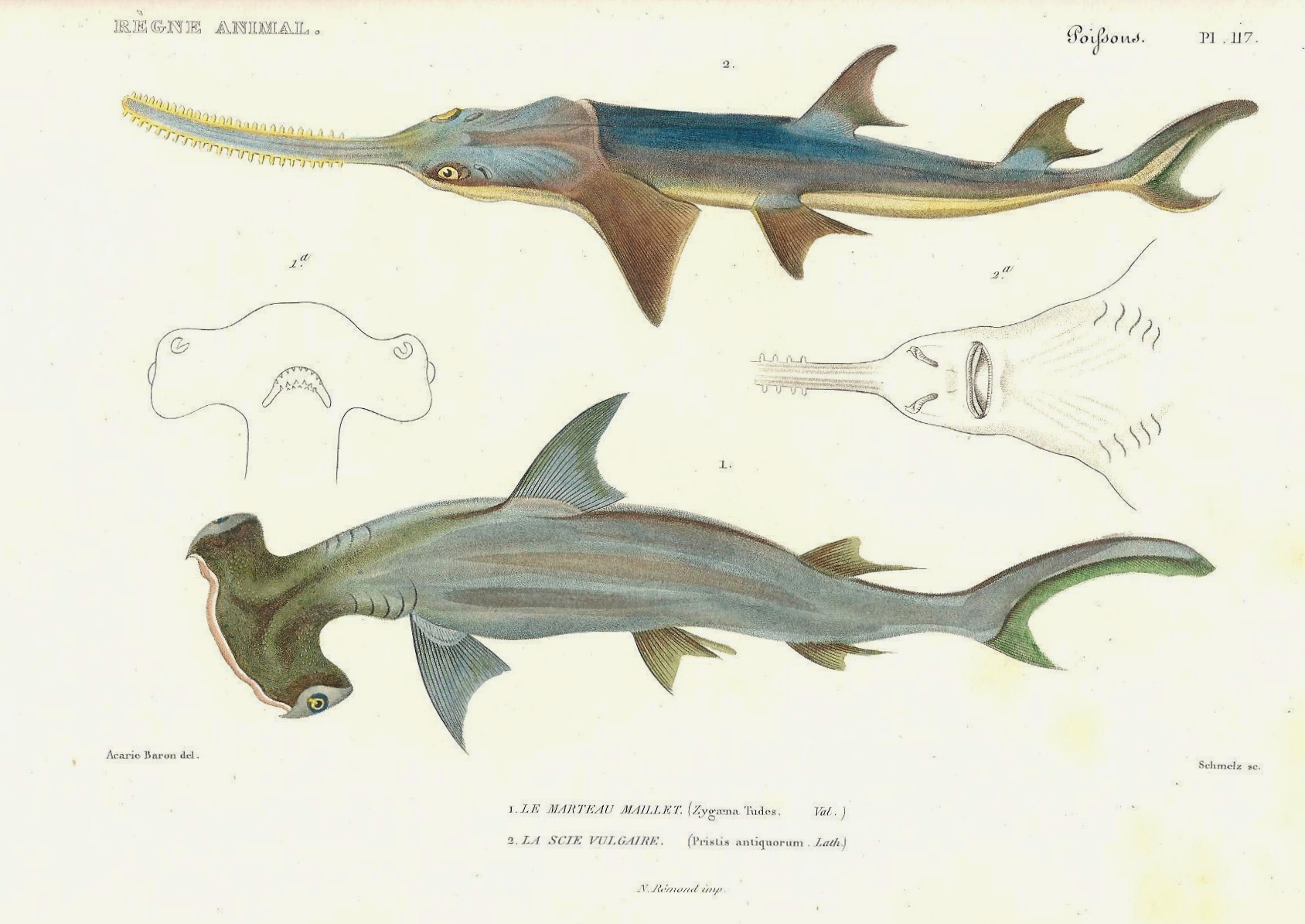
2. Histoire naturelle des poissons (1828–1849)
By Georges Cuvier and Achille Valenciennes
Few scientific works can match the ambition of Histoire naturelle des poissons. Published in 22 volumes between 1828 and 1849, it was one of the largest studies of fishes ever attempted. The work documented more than 4,500 species and became the standard reference for generations of ichthyologists.

Although not exclusively devoted to sharks, the series contains some of the earliest scientific treatments of numerous shark and ray species. Later supplementary volumes by Auguste Duméril specifically addressed groups that Cuvier and Valenciennes had largely omitted, including sharks.
Complete original sets are extraordinarily difficult to locate. Many survive only in major institutions and national libraries.
Why collectors seek it:
- One of the most important fish-science publications ever produced.
- Twenty-two volumes published over two decades.
- Includes early scientific documentation of sharks and rays.
- Considered a cornerstone of modern ichthyology.
3. A History of the Fishes of the British Islands (1860–1865)
By Jonathan Couch

Jonathan Couch was among the great natural historians of the Victorian era. His four-volume masterpiece combined careful observations with beautifully illustrated plates depicting fishes found around Britain, including several sharks and rays.
Collectors prize complete sets because many copies were broken apart over the years so individual illustrations could be sold separately as artwork.
The result is that complete, intact original sets have become increasingly difficult to find.
4. Early Editions of British Fishes
By William Yarrell
Yarrell’s books helped popularize fish study in Britain and preserved valuable observations from some of the leading marine naturalists of the nineteenth century.
Though not strictly shark books, they contain important historical references to shark species occurring around the British Isles and represent a critical period in the development of fish taxonomy.
5. Nineteenth-Century Shark Family Monographs
Throughout the 1800s, museums and scientific societies across Europe published specialized studies on dogfish, skates, rays, and shark families.
Many were printed in very limited quantities and distributed only among scientists.
Ironically, these obscure publications may be rarer today than some famous books because so few copies were ever produced in the first place.
For shark historians, these monographs often contain original species descriptions, illustrations, and observations unavailable elsewhere.
Why These Books Matter
These works were produced before scuba diving, before modern fisheries science, and before photography became commonplace in biological research.
Scientists relied on specimens brought home by sailors, fishermen, explorers, and naturalists. Every drawing was painstakingly prepared by hand. Every species account represented months or years of study.
The knowledge contained within these publications became part of the foundation upon which modern shark biology was built. They provide a fascinating window into how people understood sharks during different periods of history and how scientific thinking evolved over time.
For young people interested in marine science, conservation, and shark research, these books offer something that modern resources often cannot—a direct connection to the pioneers who first sought to understand these remarkable animals.
Building a Resource for Future Shark Researchers
The Gulf Great White Shark Society is working to expand its collection of shark reference materials as part of a growing educational and mentoring effort aimed at inspiring the next generation of shark researchers, conservationists, writers, photographers, and marine scientists.
Historical books and publications help provide context for how shark science has developed over the last two centuries. They allow students to see how discoveries were made, how species were described, and how our understanding of sharks has changed through time.
If you own original shark books, museum memoirs, scientific offprints, historical illustrations, field notes, or other shark-related publications, we would enjoy learning about them. Whether through donation, loan, digitization, or simply sharing information about their existence, these materials can help support educational programs and provide valuable historical perspective for young people entering the field.
You can email me at chester@chestermoore.com.
Chester Moore
Follow Chester Moore and Higher Calling Wildlife® on the following social media platforms
@gulfgreatwhitesharksociety on Instagram
@thechestermoore on Instagram
Higher Calling Wildlife on Facebook
Email Chester at chester@chestermoore.com.
Subscribe to the Dark Outdoors podcast on all major podcasting platforms.


Leave a Reply