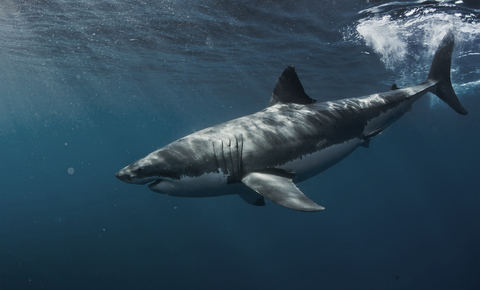
New tracking data from OCEARCH shows the Gulf is part of their seasonal range
For a long time, the Gulf of Mexico wasn’t really part of the great white shark story.
If you grew up fishing its waters or talking with charter captains along the northern Gulf Coast, you heard stories every now and then. A massive shark cut off a kingfish. A strange dorsal fin showed up in winter. Someone hauled a giant shape close to the boat before cutting the line.
But those were treated as oddities.
Most people believed great whites belonged somewhere else—Cape Cod, California, South Africa. Places where documentaries were filmed and where seals were abundant.
The Gulf was considered more of a side note.
That perception is changing, and much of the credit goes to a series of satellite tags reporting back from the ocean from conservation research group OCEARCH.
When their researchers began analyzing over a decade of tracking data, a different picture emerged. The Gulf of Mexico wasn’t just seeing the occasional wandering white shark.

It was part of their seasonal home range.
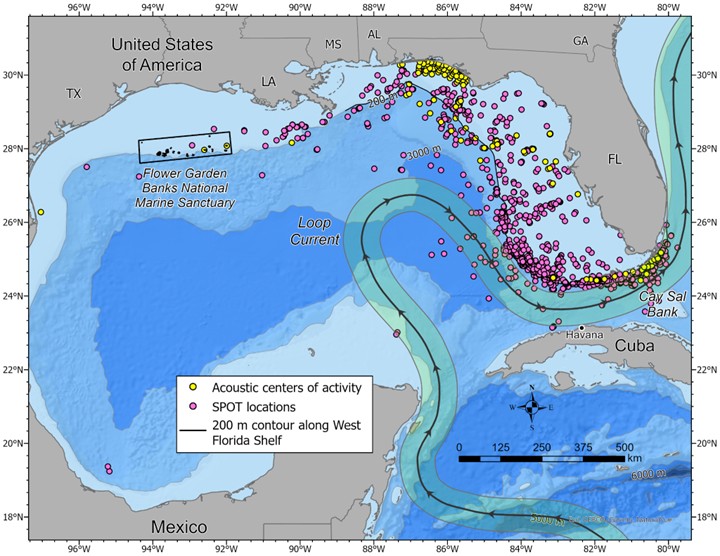
Sixty-two percent of the white sharks tagged in the western North Atlantic eventually entered the Gulf of Mexico. These weren’t just a few adventurous animals either. The list included juveniles barely past birth size, subadults still growing, and mature adults capable of crossing entire ocean basins.
Many remained for weeks, and some for months at a time.
They moved primarily along the continental shelf and its outer edge, with frequent use of adjacent slope waters, particularly along a long stretch off Florida’s Gulf coast, and followed a corridor south of the Florida Keys that functions almost like a highway between the Atlantic and the Gulf.

John Tyminski of OCEARCH admits some of the findings were a bit unexpected.
“They’re more prevalent than people thought. The Gulf is clearly part of their seasonal migration,” he said.
The discovery didn’t happen overnight. It took patience, collaboration, and a mix of technologies that together tell a story no single tag could reveal on its own.
Ocearch Following Sharks from Space
The first piece of that puzzle is the tag many people recognize from apps like Shark Tracker from OCEARCH.
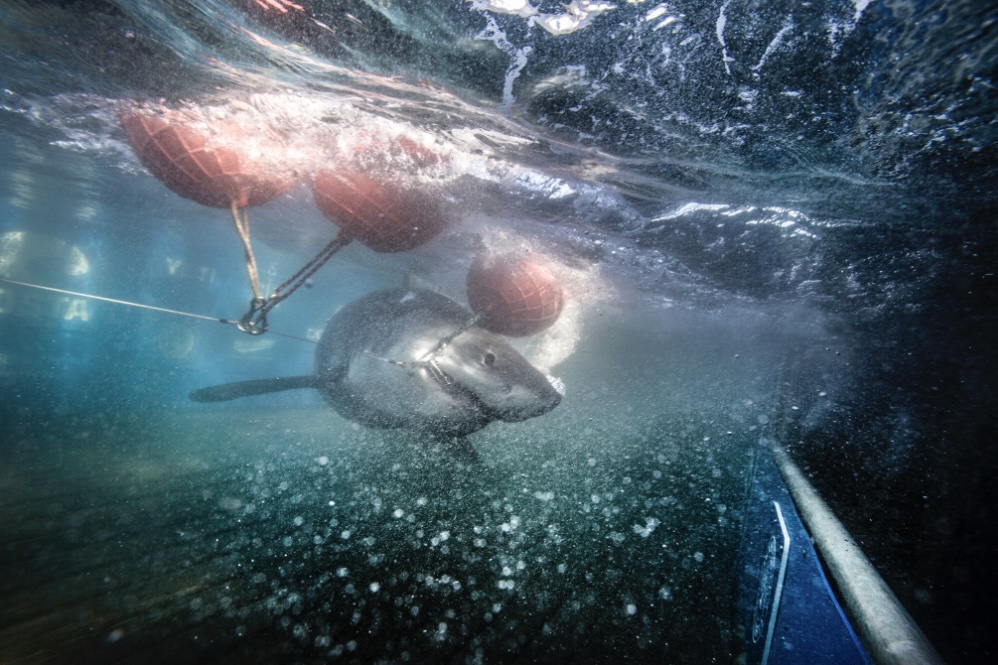
These are SPOT tags, mounted on a shark’s dorsal fin. When the animal surfaces, the tag sends signals to satellites overhead. Those signals translate into a location point.
It’s simple in theory.
In practice, it depends on the behavior of the shark.
“The animal has to come to the surface. Some sharks do that more often than others,” Tyminski said.

Researchers sometimes joke that certain sharks are “better pingers.”
Even when the system works well, it only shows part of the picture. A location point tells you where a shark surfaced, but not what it was doing beneath the surface.
That’s where the second tag comes in.
Pop-up satellite archival tags collect a completely different kind of information. Instead of transmitting regularly, they record light levels, depth, and temperature as the shark swims through the ocean.
Months later the tag releases from the shark, floats to the surface, and transmits a summary of the stored data.
If the tag is physically recovered, the information inside can be extraordinary.
“You get this incredibly detailed record of what that shark was doing in the water column,” Tyminski explained.
The final piece of the system is acoustic telemetry.
These tags are implanted inside the shark and emit a unique sound signal. Underwater receivers placed along coastlines and research stations listen for those signals. When a shark swims within range, the receiver records the detection.
Unlike satellite tags, acoustic tags can last nearly a decade.
But their real strength comes from cooperation.
Receivers placed in the water for one species often detect many others. A receiver deployed for sturgeon, tarpon, or redfish may also log the passage of a white shark moving through the same waters.
Those shared detections help scientists build a broader picture of animal movement across the entire Gulf and Atlantic coast.
The Panama City Surprise
That collaboration led to one of the more surprising discoveries of the project.
The Panama City Beach area showed up repeatedly in the data, largely because of a strong network of acoustic receivers in that region.
Satellite tags alone suggested that most white sharks remained offshore along the continental shelf. But acoustic detections revealed that some animals were coming much closer to that stretch of Florida shoreline than anyone expected.
“That was a surprise,” Tyminski said.
Without the acoustic network, those movements might have gone unnoticed.
Most of the sharks still appear to favor deeper water along the shelf edge, but the Panama City detections showed that at least occasionally, white sharks move into nearshore Gulf waters.
It’s a reminder that even with modern tracking technology, the ocean still keeps its secrets.

What the tags did confirm with certainty is the timing of the sharks’ visits.
Winter is when the Gulf becomes important.
Between December and May, detections rise sharply. January through April appears to be the peak period, when the greatest number of sharks occupy the region.
For animals that spend the summer in the colder waters of the North Atlantic, the Gulf offers a very different environment.
Warmer temperatures.
A wide continental shelf.
And a range of prey species from large schooling fish to marine mammals.
A Mysterious Ridge
Many of the sharks entering the Gulf follow the same route.
They pass through the Straits of Florida, moving south of the Florida Keys before turning west into the Gulf basin. Once inside, their movements tend to trace the contour of the continental shelf.
One feature in particular stands out.
Pulley Ridge.
Most people outside the marine science world have never heard of it. Yet this limestone ridge stretches for nearly three hundred kilometers along the southwestern edge of Florida’s continental shelf.
The tracking data showed white sharks returning to this area repeatedly.
That pattern suggests something scientists call philopatry—the tendency of animals to return to the same place year after year.
It’s behavior seen in several shark species, but seeing it documented in the Gulf of Mexico was an important step forward in understanding how these predators use the region.
Some sharks linger in the Gulf for only a few weeks.
Others remain for months before beginning the journey back into the Atlantic.
One female even approached the coast of Veracruz, Mexico, demonstrating that these sharks routinely cross international boundaries during their migrations.
Those movements highlight an important reality about large marine predators.
They do not recognize borders.
A shark that spends winter along the Florida shelf edge may later swim through Cuban waters or the Yucatán Channel before returning north along the Atlantic coast.

Protection in one nation’s waters only goes so far.
Outside those protections, sharks may encounter commercial fisheries where they are caught intentionally or taken as bycatch in longlines and drift nets.
The idea that great white sharks don’t belong in the Gulf of Mexico is fading fast.
In its place is a new understanding built not on stories, but on years of data mapping their movements across an entire ocean basin.
The Gulf isn’t an exception.
It’s part of the pattern.
Chester Moore
Follow Chester Moore and Higher Calling Wildlife® on the following social media platforms
@gulfgreatwhitesharksociety on Instagram
@thechestermoore on Instagram
Higher Calling Wildlife on Facebook
Email Chester at chester@chestermoore.com.
Subscribe to the Dark Outdoors podcast on all major podcasting platforms.





Leave a Reply